
Data Science Course in Bangalore with Placement Assistance
(NASSCOM FutureSkills Prime Certified | TIH at IIT Bombay Certification Program)
Data Analytics | Artificial Intelligence
Machine Learning | GenAI | Agentic Ai
Online Training & Classroom Training
Unlock Early Bird Discounts – Grab Your Seat Now
Looking to build a career in Data Science? Innomatics Research Labs runs a hands-on Data Science course in Bengaluru, covering Data Analytics, Machine Learning, AI, Generative AI, and Agentic AI. Freshers, graduates, and working professionals train through live projects and real-world case studies. Both online and classroom batches are available, backed by dedicated placement support. NASSCOM FutureSkills Prime certification and the TIH at IIT Bombay certification program are available to eligible learners.
- Access to Live Class Recordings
- Lifetime LMS Access
- 20,000+ Career Transitions in Data Analyst, ML & AI Roles
- Dedicated Placement Support Team
- 650+ Hiring Partners Across Industries
- 550+ Successful Batches Completed
- 1-on-1 Career Guidance from Industry Mentors
Enroll Now
NASSCOM Futureskills Prime Certified
Data Science Course Curriculum (Syllabus)
Introduction to Python Programming
- What is Python programming language?
- Why Python programming language required for Data Science?
- What is Anaconda? Installation of Anaconda
- Understanding Jupyter notebook & Basic commands
- Understanding Python Syntax
- Data types in python broadly discussed
Literals, Keywords and Data Types
- What is an Identifier? Rules for Identifier Naming
- Inbuilt Keywords, Variables and Data Types
- print() and input(), Python Operators
- Arithmetic, Assignment, Comparison, Logical, Identity operators
Conditional Statement
- if, if-else, if-elif-else, nested if, elif ladder
While Loops & Control Flow
- while loop syntax, Control Flow, Pattern Problems
Lists, Tuple & Set
- Lists: define, access, indexing, slicing, built-in methods
- Tuple: create, access, differences with list
- Set: create, built-in methods, set operations
Dictionary & Strings
- Dictionary: create, add, modify, retrieve values
- Strings: create, indexing, slicing, built-in methods
- Mutable vs Immutable Data Types
For Loop & Functions
- For loop, range(), enumerate(), For-else
- List & Dictionary Comprehension
- Functions: define, call, positional/keyword args
- Lambda, Map, Filter & Reduce
Modules, OOPS & File Handling
- Modules & Packages: Datetime, Random, math, os
- Classes, Objects, Constructor, Access modifiers
- Inheritance, Abstraction, Polymorphism, Encapsulation
- File Handling & Exception Handling
VS Code & Streamlit Deployment
- What is Streamlit, Components, Creating application
- VS Code, Setting Environment
- Backend with FastAPI, Client Server Architecture
- Integration of FastAPI with Streamlit
Introduction to EDA
- How is EDA different from python programming?
- EDA vs Python with case study
- Types of data (Numerical, Categorical)
- Types of Analysis (Nonvisual and visual, Univariate and Bivariate, Descriptive, Inferential & Probabilistic)
Descriptive Statistics
- What and why Statistics? Data and its Measures
- Measures of central tendency (Univariate Analysis)
- Measures of dispersion (Bi Variate)
Core Numpy Operations
- Generating Random Numbers, Indexing and Slicing
- Boolean Arrays, Updating, Insert, Append, Delete
- reshape, ravel, flatten, transpose
- Mathematical & Statistical Functions
- Vectorization and Advanced Numpy Functions
Introduction to Pandas
- Pandas Series & DataFrame
- Data Exploration and Understanding
- Loading data from csv and excel files
- Groupby, Pivot, Joins (Merge Operation)
- Handling Missing Values, String and Datetime Manipulations
- Advanced Data Transformations: apply(), map(), Window functions
Data Visualization
- Univariate analysis with Matplotlib/Seaborn
- Bivariate and Multivariate analysis
- Scatter plot, heat map, pairplot, boxplot, violin plot
Probability & Distributions
- Introduction to Probability, Conditional Probability
- Discrete: Bernoulli, Binomial, Poisson
- Continuous: Uniform, Normal, Exponential, Log Normal
- 68-95-99.7% Rule, QQ Plot
Inferential Statistics
- Population vs Sample, Sampling Techniques
- Central Limit Theorem, Confidence Interval
- Hypothesis Testing, p-value, Type I & II Errors
- chi-square test, ANOVA
Web Scraping & EDA Project
- Regular Expressions, Pattern Matching
- Requests Library, BeautifulSoup, HTML Parsing
- Data Cleaning & Preprocessing
- Project: Collect, clean, analyze real-time data
Introduction to SQL
- Data, Database, DBMS, RDBMS
- SQL vs MySQL, SQL vs NoSQL
- CRUD operations, Pandas vs SQL
Data Exploration and Filtering
- Client Server Architecture, Workbench
- SELECT, Data Exploration, Filtering
- LIKE, Regexp, Between operators
Clauses
- GROUP BY, HAVING, ORDER BY, CASE
- Order of execution
Multiple Tables & Joins
- Primary key, Foreign key, ER diagram
- Inner, Outer, Left, Right, Cross, Self Join
- UNION, UNION ALL, Subquery
- Temporary Tables, CTE, Window Functions
SQL Fundamentals & Advanced
- DDL (CREATE, ALTER, DROP, TRUNCATE)
- DML (Insert, Update, Delete)
- Views, Stored Procedure, Functions
- Transaction Control, ACID, Triggers
Project on MySQL
- Analyze normalized relational databases
- Write advanced SQL with CTEs, Views, Stored Procedures
- Solve domain-specific business problems
Introduction To Power BI
- What is Business Intelligence?
- Power BI Introduction, Quadrant report
- Comparison with other BI tools
- Power BI Desktop overview & workflow
Data Import And Visualizations
- Data import options, Import from Web
- Categorical data visualization, Trend Data viz
Power Queries
- Power Query Introduction, Data Transformation
- M Language briefing, Power BI Datatypes
- Filtering, Column & Row Transformations
- Combine Queries, Merge Queries
Power Pivot And DAX
- Intro to Data Modeling, Relationship and Cardinality
- Calculated Columns vs Measures
- DAX: logical, text, math, statistical, filter, time intelligence functions
- Creating a Date Dimension table
Login, Publish & RLS
- Power BI services, Dashboard creation
- Sharing your dashboard, RLS introduction
- Conditional Formatting, Drill Through, Drilldown
Project on Power BI
- Build data models and establish relationships
- Design interactive dashboards and reports
- Generate insights across multiple industry domains
ML vs DL vs AI
- AI vs ML vs DL
- Supervised vs Unsupervised Learning
- Classification Task, Regression Task
Data Preprocessing Pipelines
- Intro to Numerical & Categorical Data Preprocessing
- Nominal Encoding, Ordinal Encoding
- Introducing sklearn module
Text & Image Preprocessing
- Text Data: Tokenisation, Stop Words, Lemmatization, Stemming
- Bag of Words, TF-IDF, Spam-Ham Detection
- Image Data: RGB channels, Images as 3D numpy arrays
KNN, Naive Bayes, Decision Tree
- kNN for Classification & Regression
- Classification & Regression Evaluation Metrics
- Naive Bayes Derivation & Code Implementation
- Decision Tree: ID3, C4.5, Entropy, Gini Impurity
Linear & Logistic Regression
- Simple & Multiple Linear Regression
- Gradient Descent, Regularization
- Logistic Regression: Sigmoid, Decision Boundary
SVM & Ensemble Methods
- Support Vector Machines, Kernel Trick
- Bagging: Random Forest
- Boosting: ADABoost, GBDT, XGBoost
Unsupervised Learning & PCA
- K-Means, K-Means++, Hierarchical Clustering
- Customer Segmentation
- PCA, Dimensionality Reduction
Project on Machine Learning
- End-to-end ML pipelines
- MLflow for experiment tracking
- Deploy ML applications using Streamlit
Introduction to Deep Learning and ANN
- Biological Neuron vs Artificial Neuron
- Single Layer Perceptron Model
- Weights, Bias and Activation
- MLP / FCNN / ANN Model
Training Neural Network
- Forward pass with formulation
- Backward Pass & Backpropagation
- Classification & Regression Model Building using TensorFlow/Keras
Activation Functions & Optimizers
- Linear, Sigmoid, Tanh, ReLU, Leaky ReLU, Softmax
- Gradient Descent, Mini Batch, Momentum
- Adam, RMS Prop, Adaptive Gradient
Overfitting & Regularization
- L1 and L2 Regularization
- Dropout Regularizer, Early Stopping
- Batch Normalization
Hyperparameter Tuning with Optuna
- Introduction to Optuna, Creating a Study
- Finding & Importance of Hyperparameters
Project on ANN
- Build supervised ANN models
- Optimize using hyperparameter tuning
- Deploy using Streamlit
Introduction to NLP
- Text Preprocessing: BOW, TF-IDF
- Word Embeddings: Word2Vec, CBOW, Skip-gram
- Text Classification Case Study
Sequence Modelling
- Intro to RNN, Training of RNN, Types of RNN
- LSTM, GRU, Limitations of RNN
- POS Tagging
Self Attention & Transformers
- Seq2Seq Architecture, Attention Mechanism
- Transformer Architecture, Positional Encoding
- Self and Multihead Attention
- GPT (Autoregressive) & BERT (Auto-encoding)
HuggingFace API
- HuggingFace Embeddings
- Sentiment Analysis, NER, POS, Q&A
- Text Generation, Summarization, Translation
- Image & Audio Classification
Evaluation Metrics
- BLEU, ROUGE, METEOR, Perplexity
Project on NLP
- Sentiment Analysis, Text Classification, Spam Detection
- Build scalable NLP solutions
- Deploy NLP applications using Streamlit
Introduction to Generative AI & LLMs
- What is GenAI? Large Language Models
- OpenAI / Gemini API / Groq API authentication
- Prompt Engineering: Temperature, top-p, System & User prompts
Introduction to LangChain
- Import Chat Models, LCEL Chain
- Prompt Template, Chat Prompt Template
- Output Parser: StrOutputParsers, Pydantic Parser
- Runnables: Passthrough, Parallel
Conversation Memory & Monitoring
- Adding memory to LangChain applications
- Context Window Optimization
- Observability Tools, Tracing Implementation
RAG Fundamentals
- Document loaders (PDF, web, CSV)
- Text splitters, chunking, Vector Database
- Keyword, Semantic and Hybrid Search
- Re-ranking, RAGAS evaluation, LLM-as-a-judge
Tool Calling & Agents
- ReAct loop, Build ReAct Agent
- Custom tools (search, wikipedia)
- MCP Client Server Architecture
LangGraph
- StateGraph: nodes, edges, Sequential, Parallel, Conditional Workflows
- Conversational Chatbot with Memory and Tool
- Streaming, Human In The Loop, LangGraph Deployment
Fine Tuning & Projects
- LoRA, QLoRA, PEFT, Bits and bytes
- Project: AI Chatbots, Document Q&A, RAG pipelines
- Project: Agentic AI for Automation, Research Assistance
Intro to Images & OpenCV
- How Images are formed and stored in machines
- Introduction To OpenCV: Read, Write and Save images
- Converting Color Spaces (RGB, BGR, HLS, HSV)
- Bitwise Operators, Drawing on images
- Edge detection, Blurring, Histograms
- Read videos, Capturing images with web camera
Convolutional Neural Networks
- Introduction to CNN, Why CNN over MLP
- Convolution on Color & Grayscale images
- Padding, Stride, Maxpooling Operations
- Image Classification: HandWritten Dataset, Face Mask Detection
CNN Architectures & Transfer Learning
- AlexNet, VGG16, Inception, ResNet, Skip Connections
- Plant Diseases Prediction using Transfer Learning
- CIFAR using Transfer Learning
Object Detection
- R-CNN, Fast R-CNN, Faster R-CNN
- YOLO Algorithm: How it works, Introduction to Roboflow
- Case Study: Helmet Detection using YOLO
Image Segmentation
- Introduction to Image Segmentation
- Case Study on Image Segmentation
Project on Computer Vision
- Object Detection, Face Recognition, Image Classification
- Integrate CV pipelines with live webcam/video streams
- Deploy using Streamlit
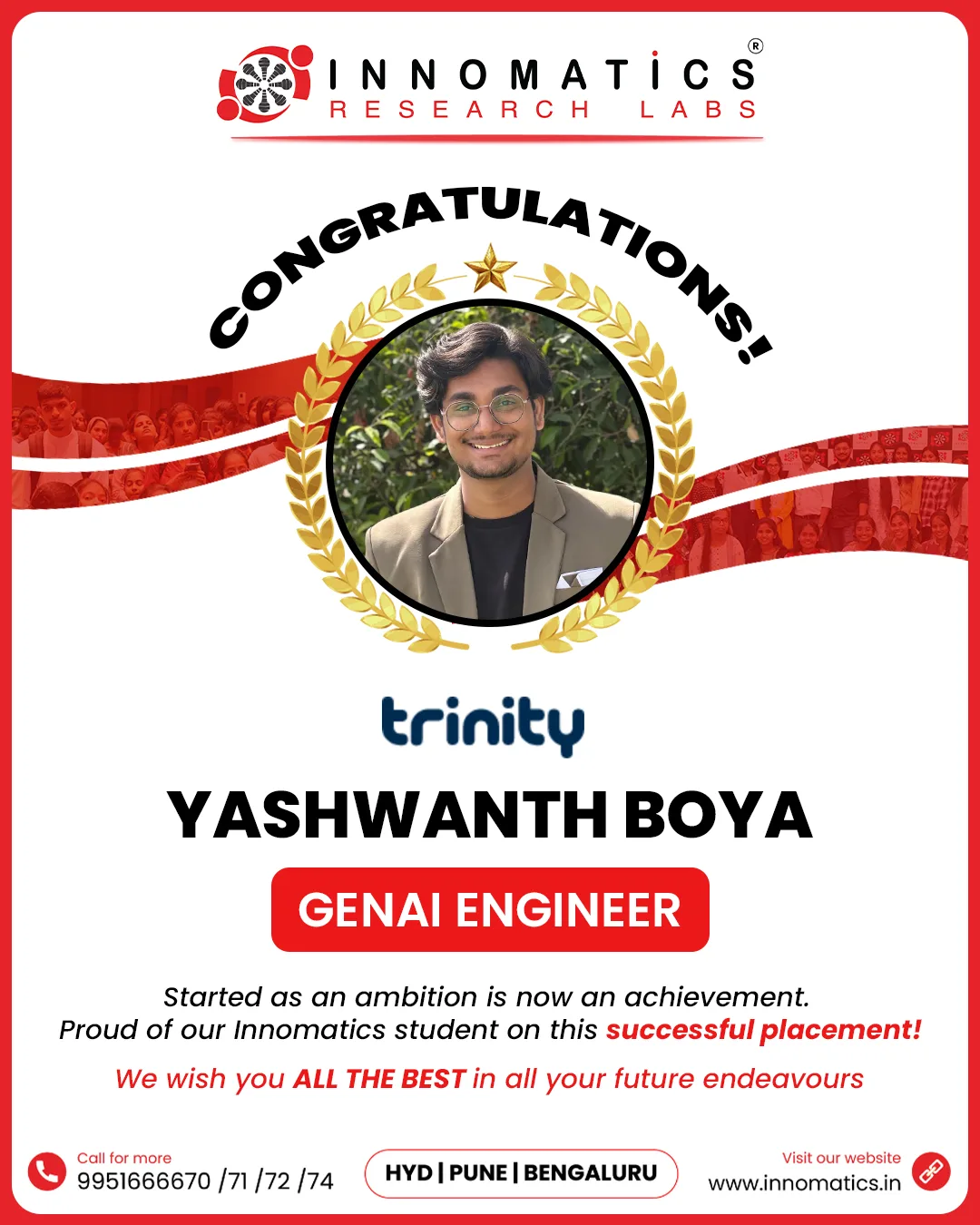
Meet Our Recently Placed Students
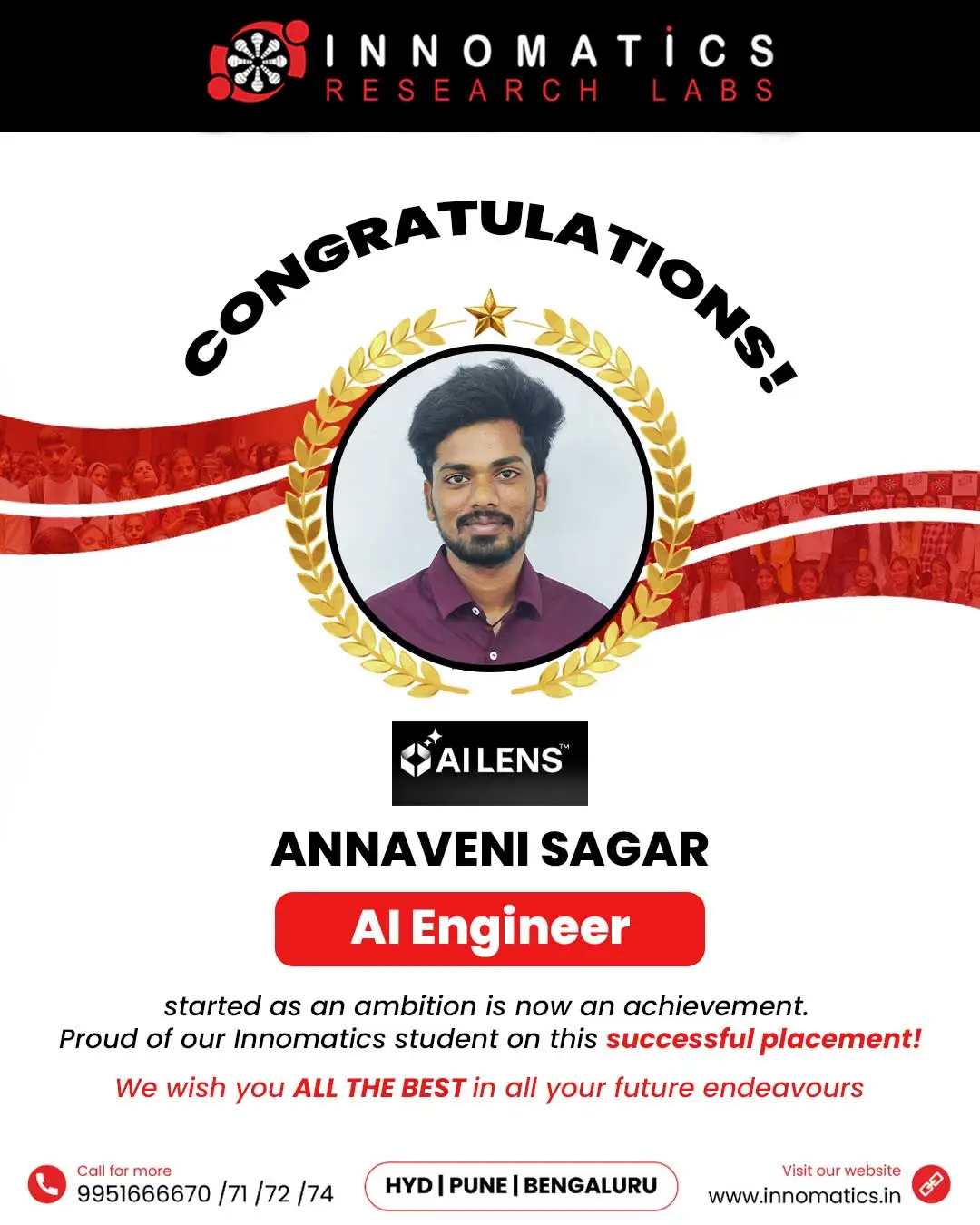
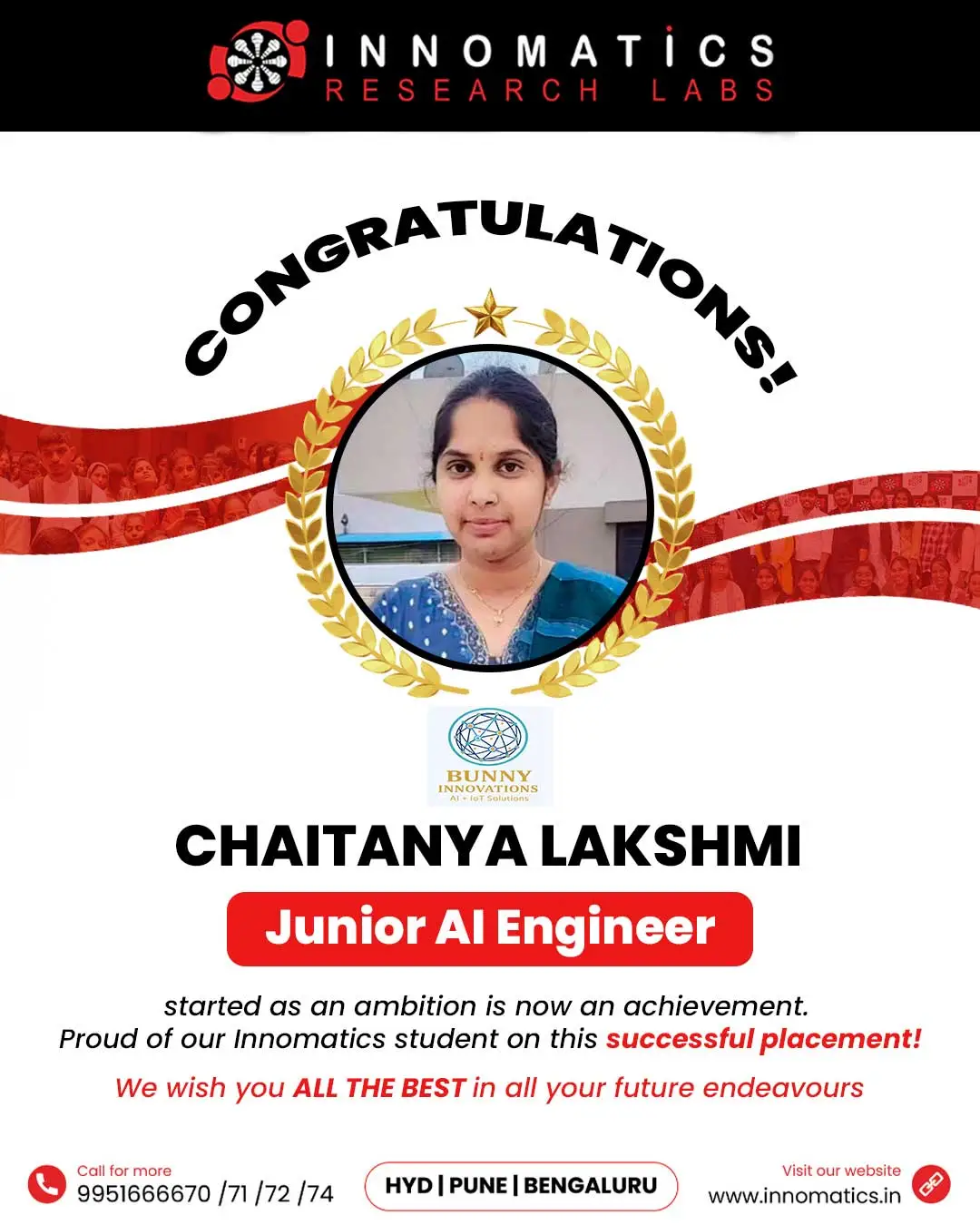
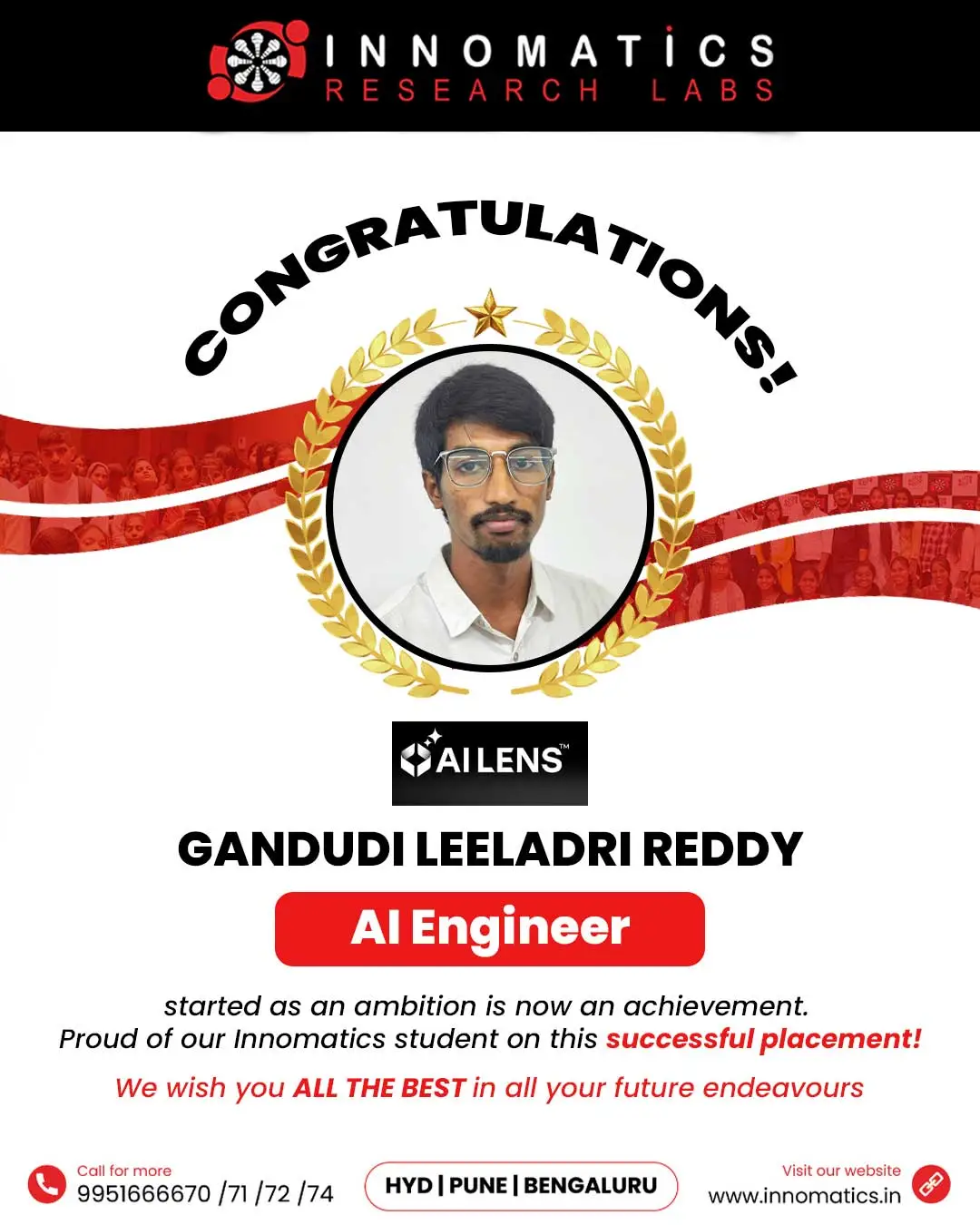
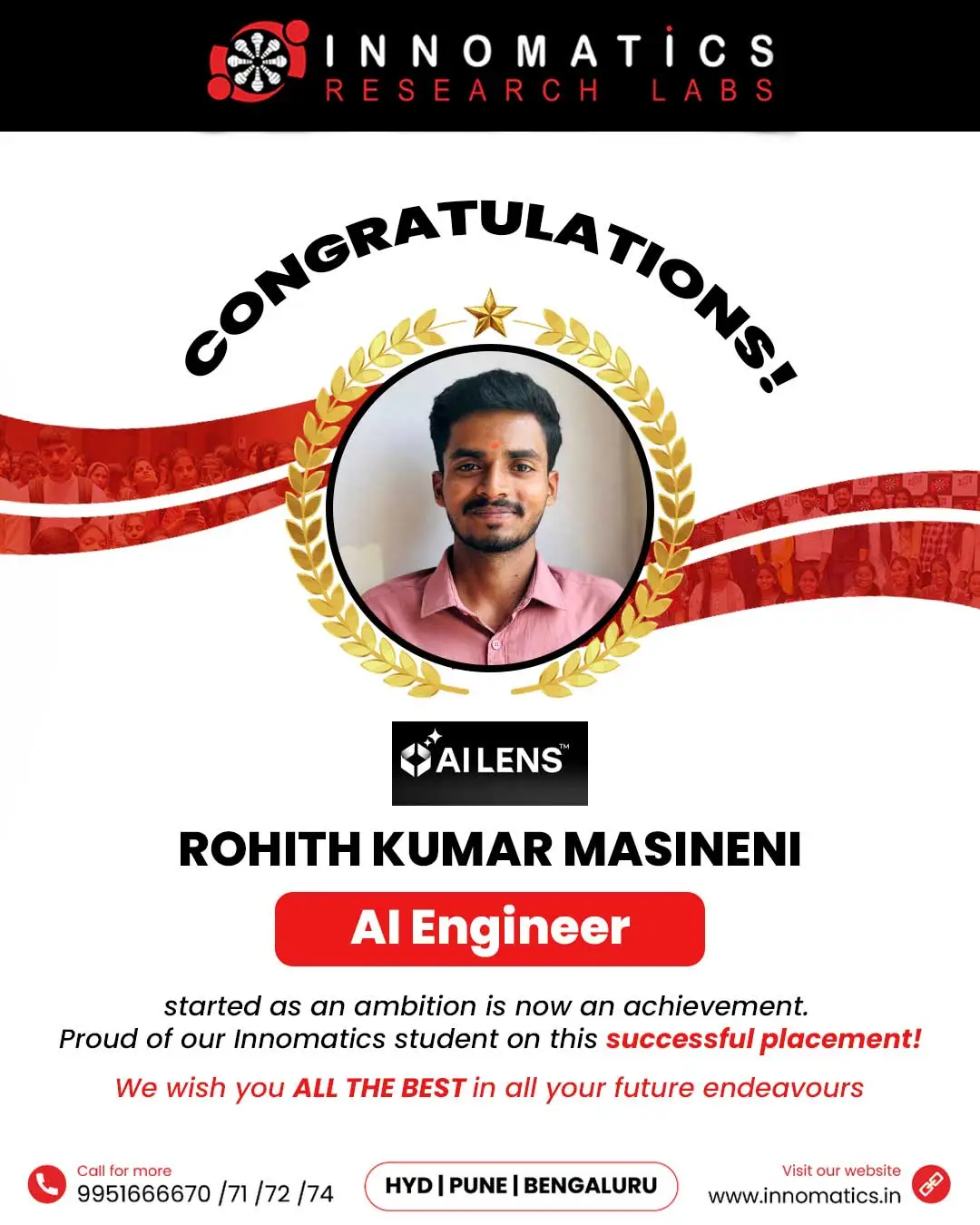

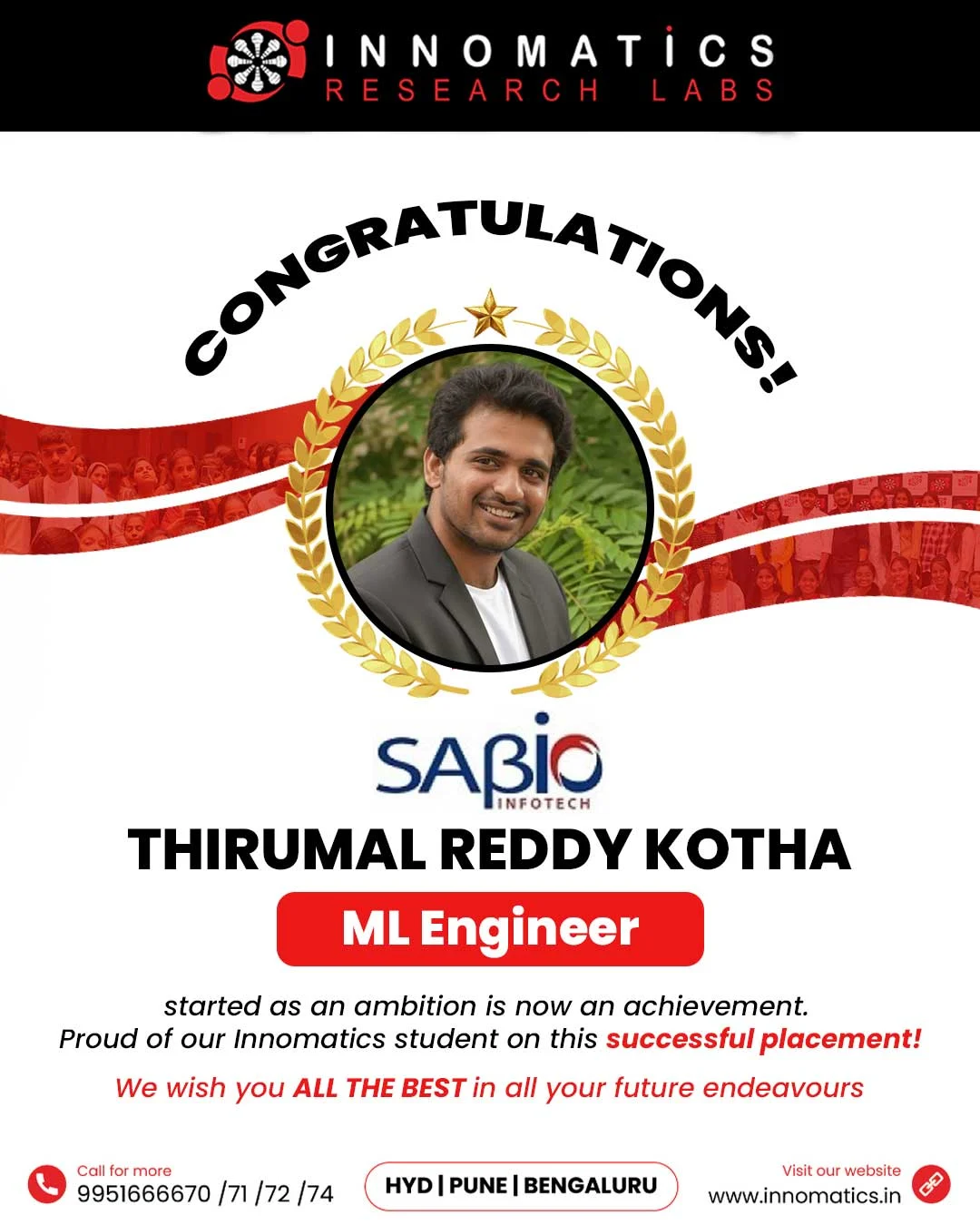
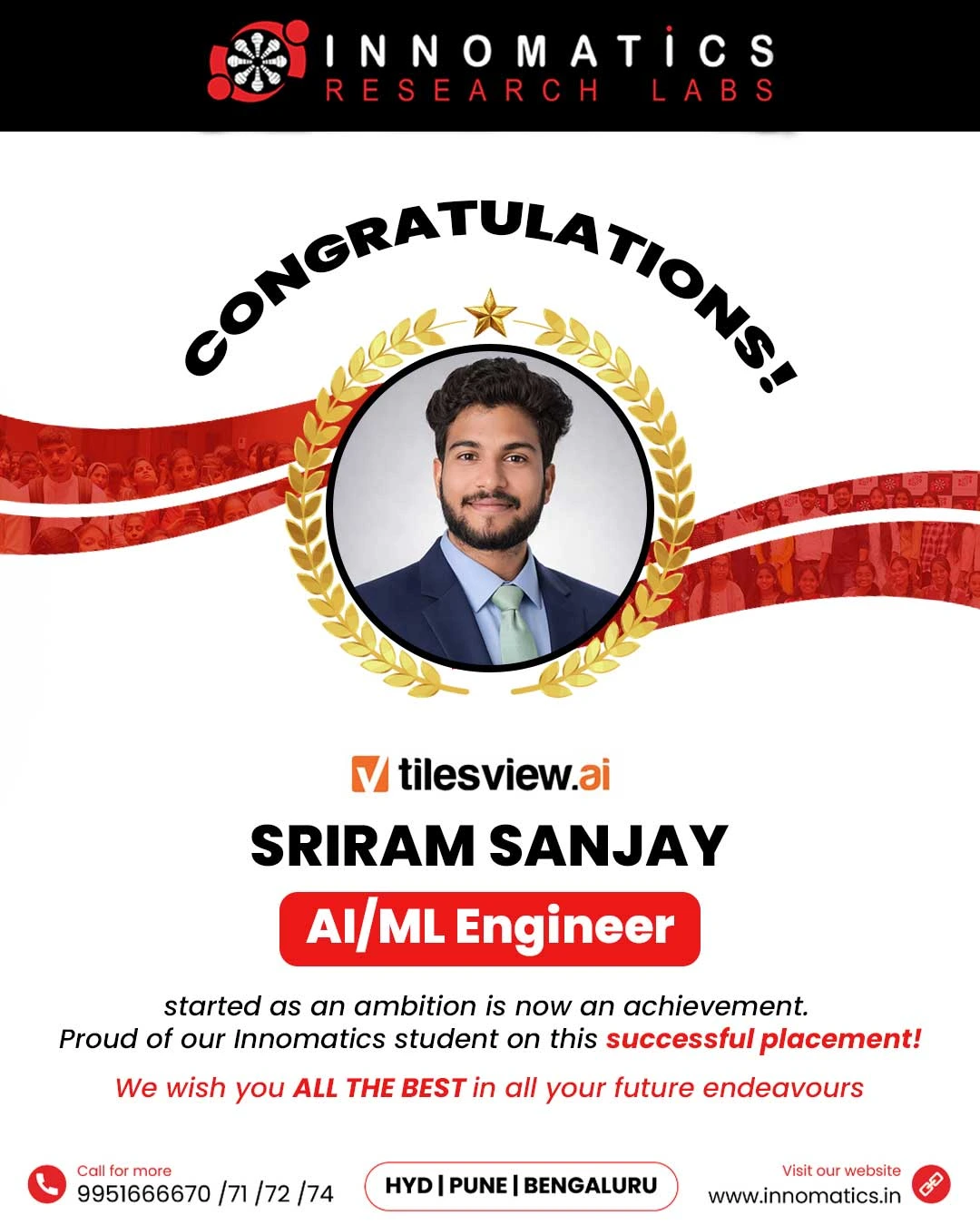
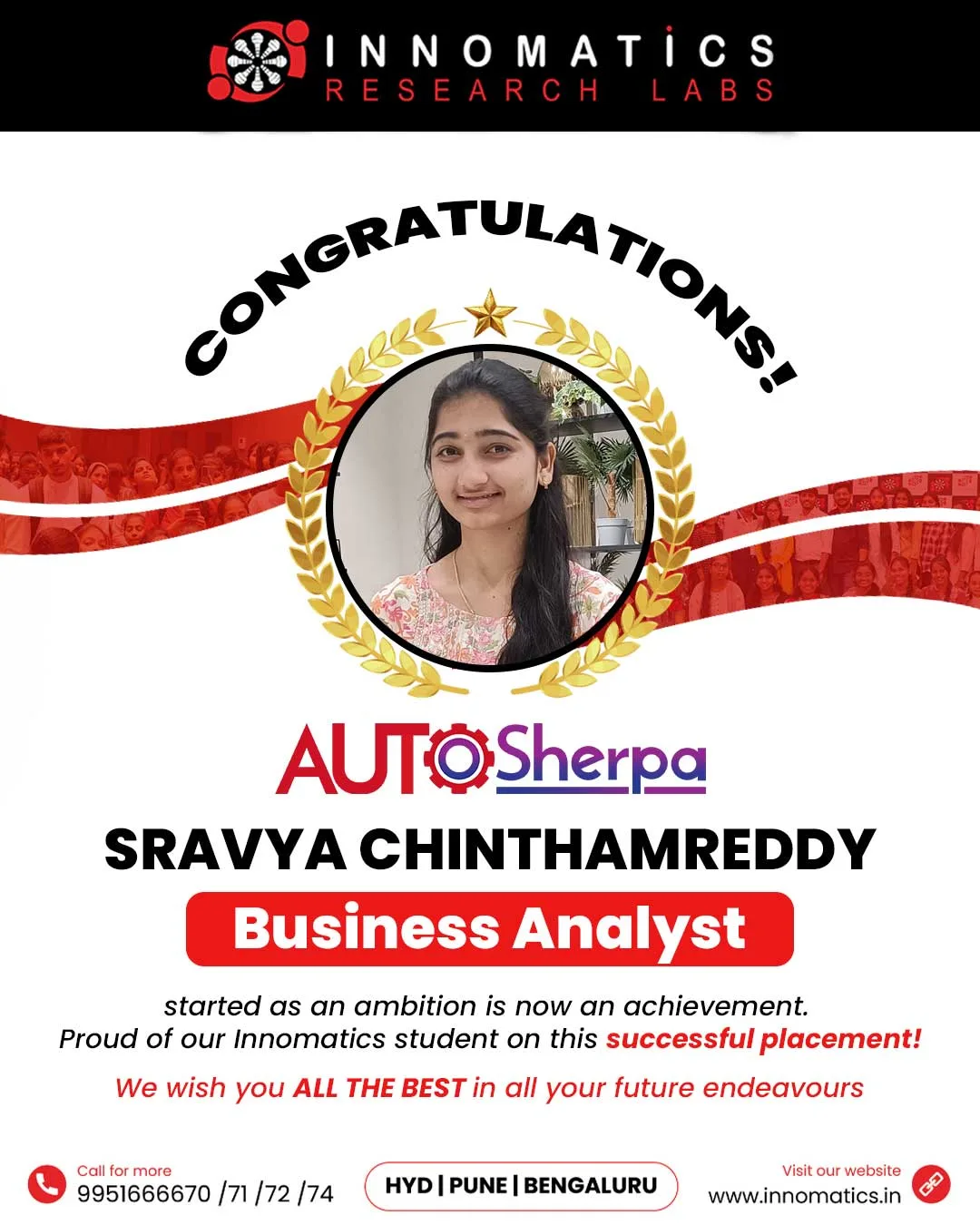
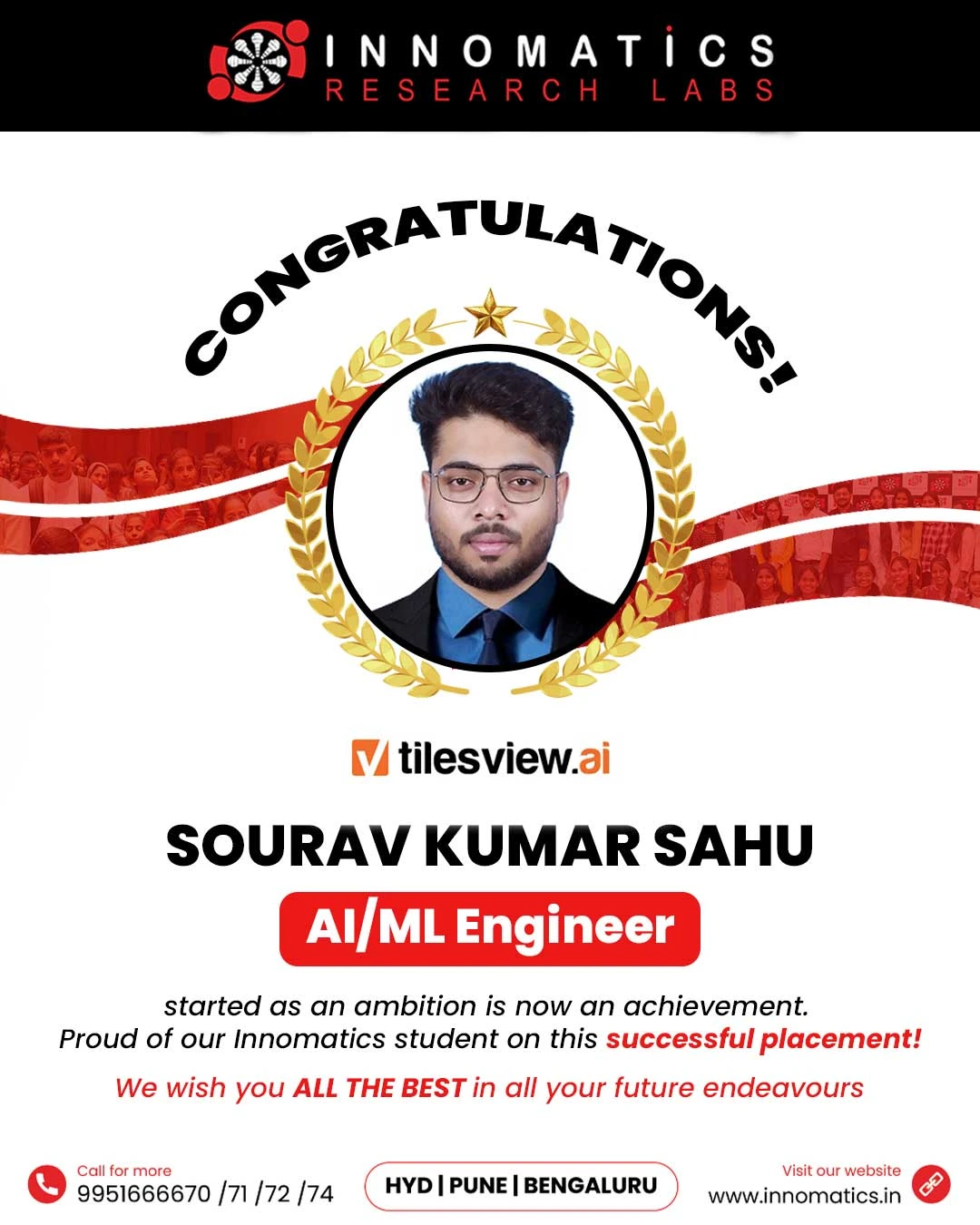
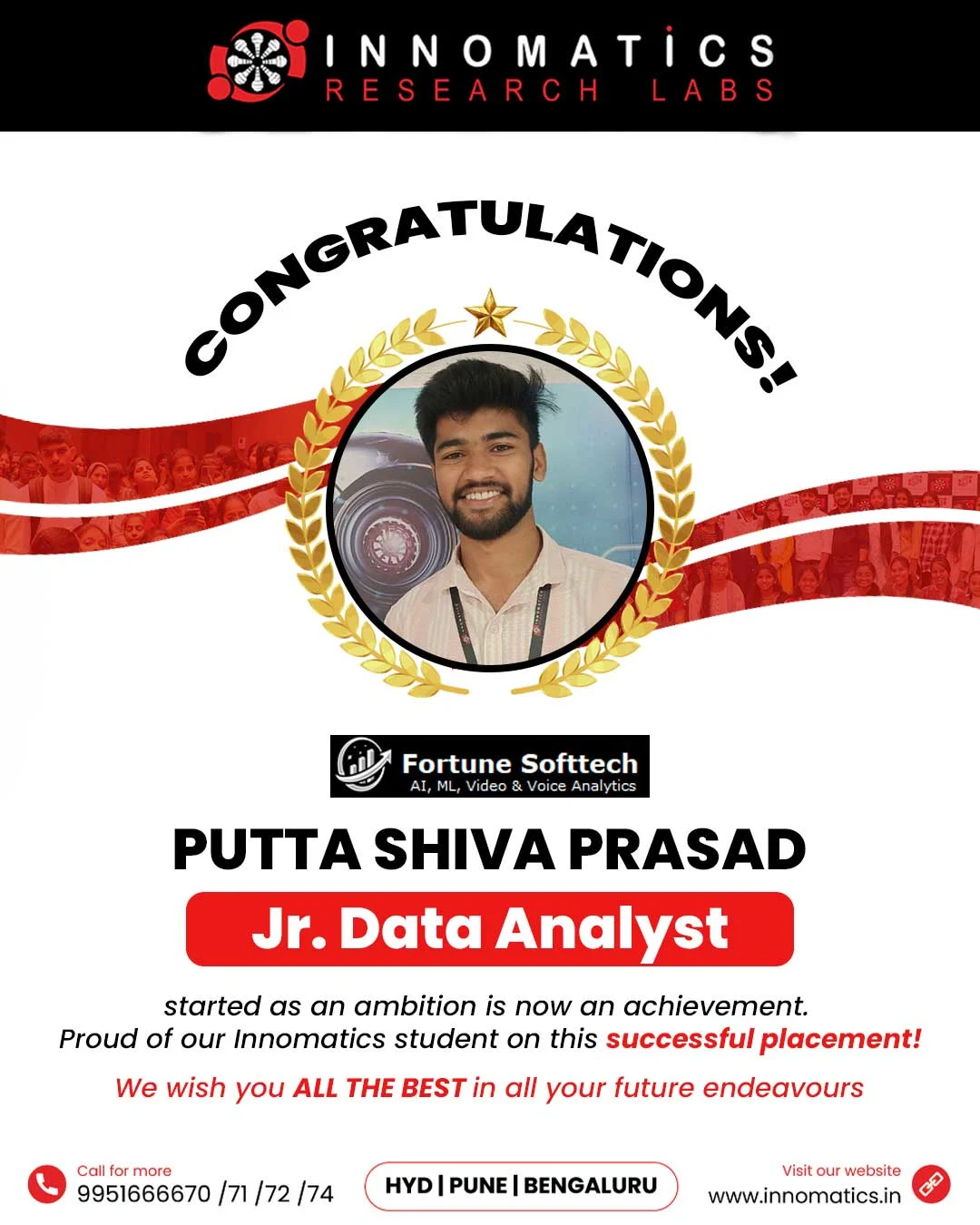
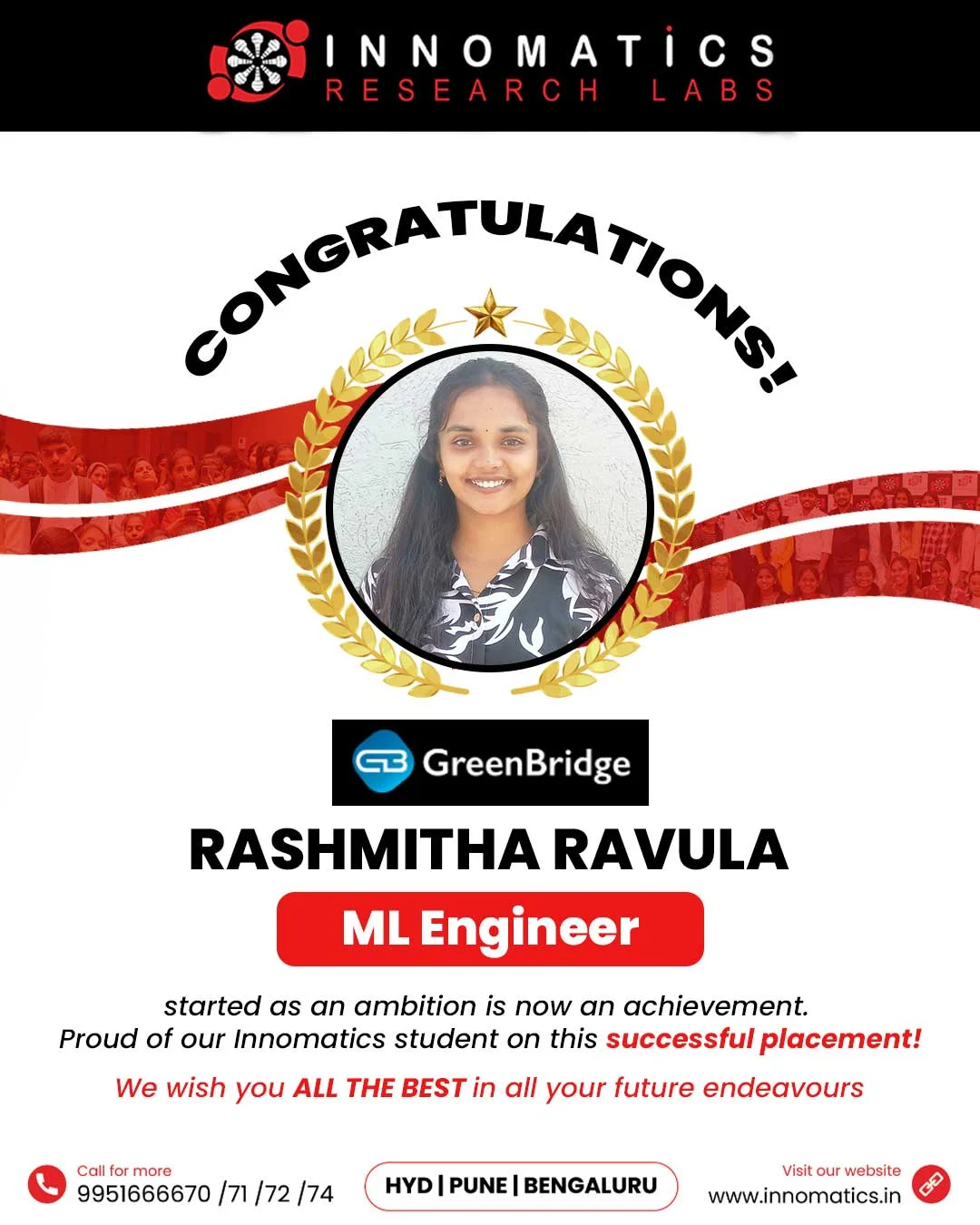
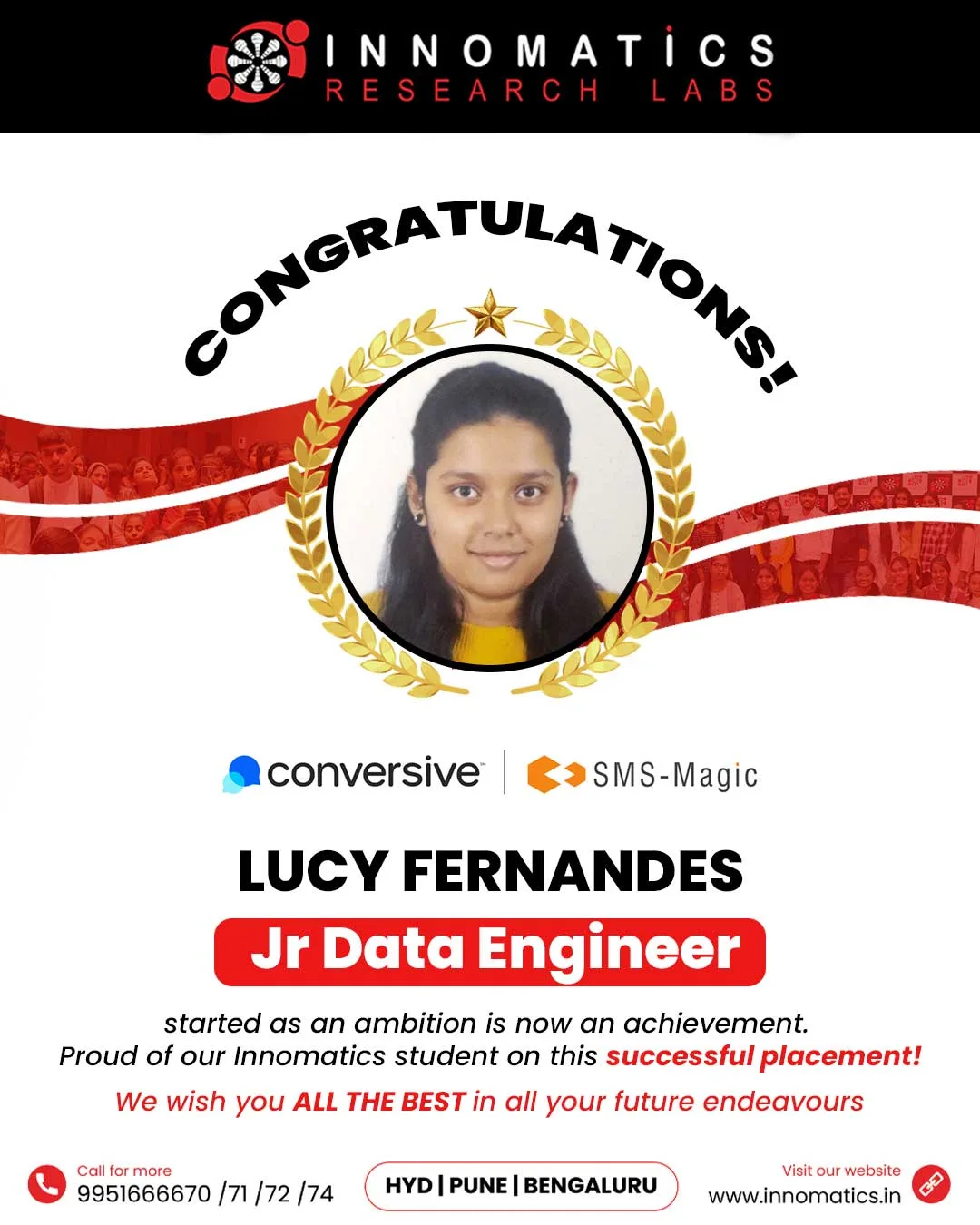
Success Stories of Innomatics Alumni

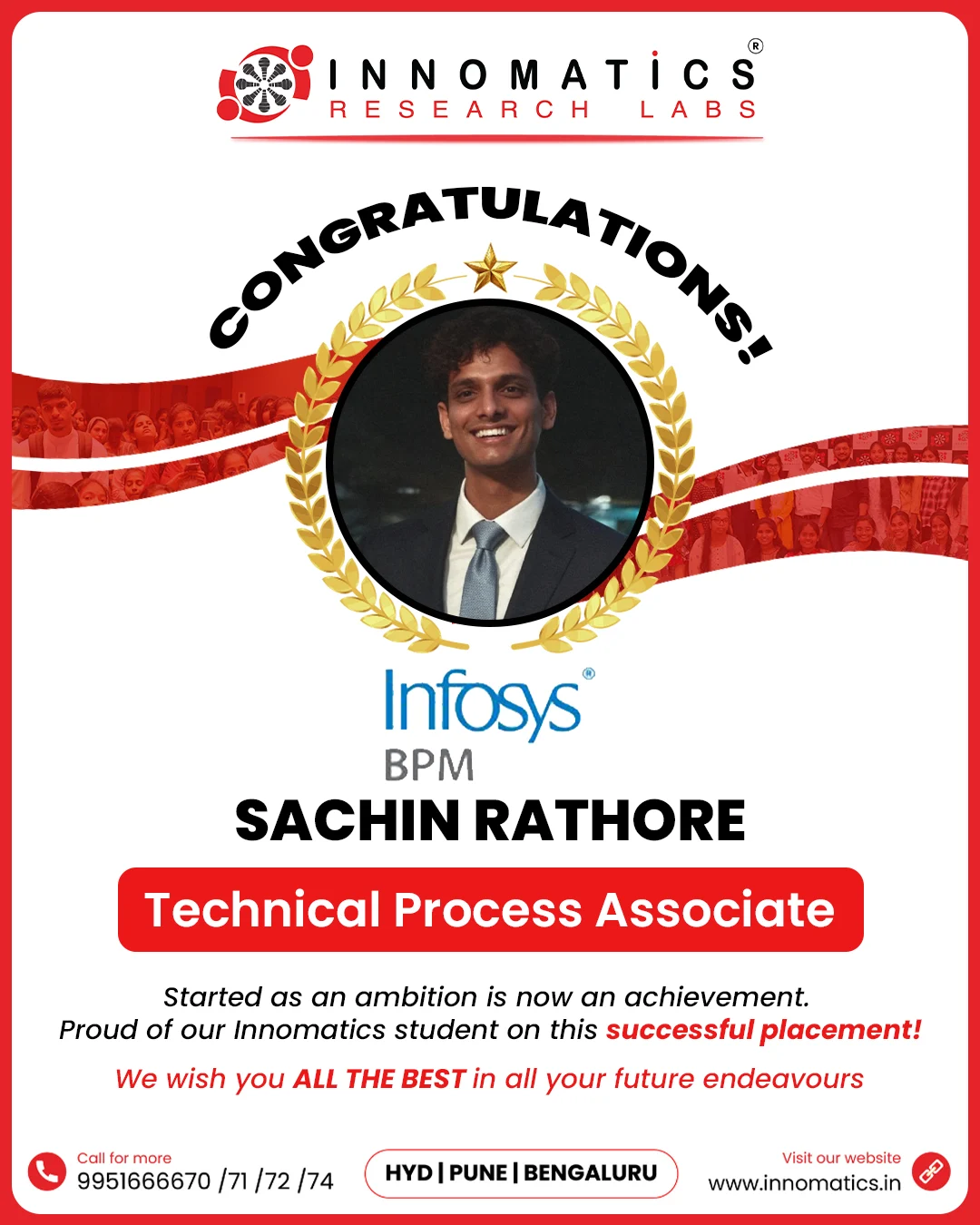
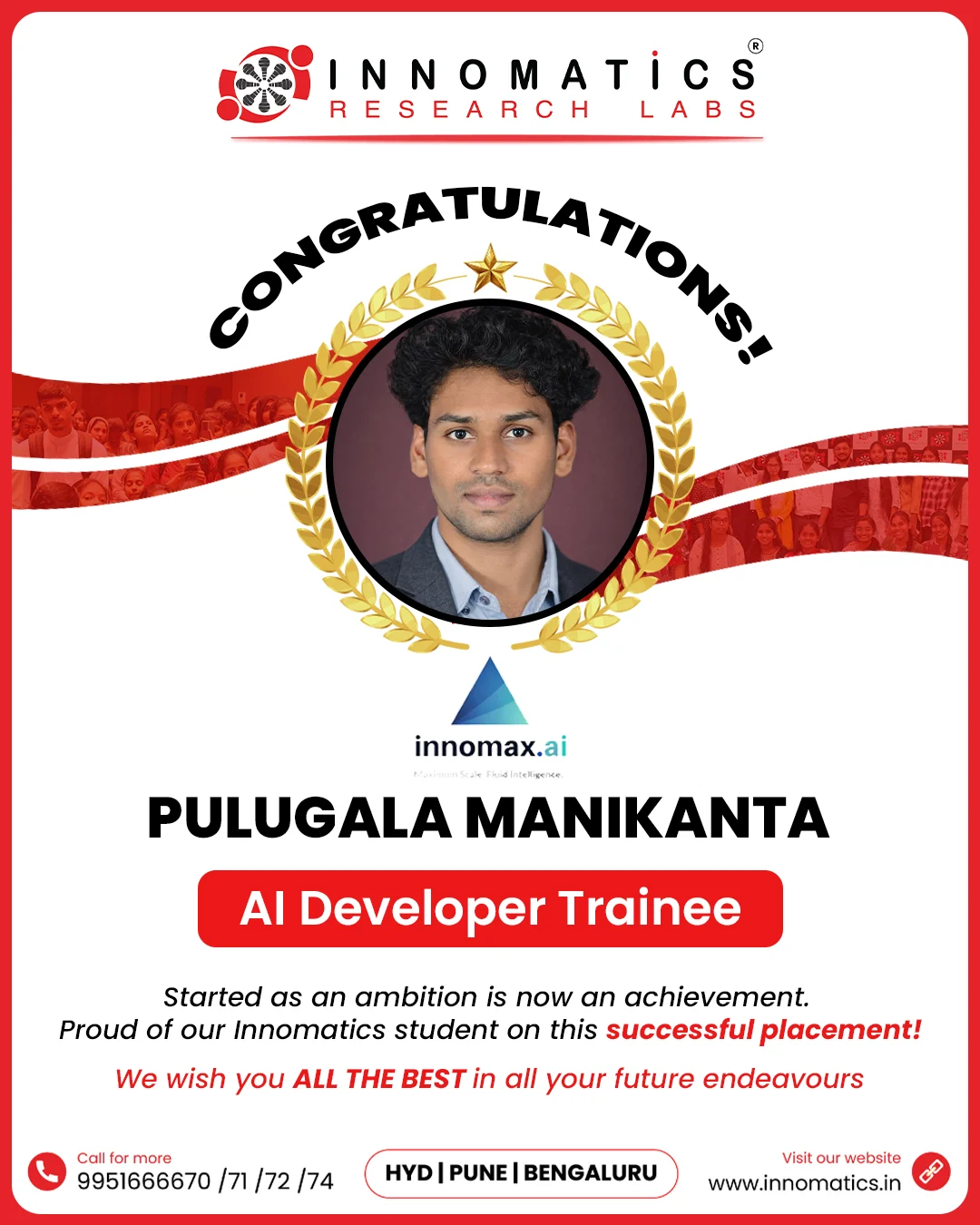
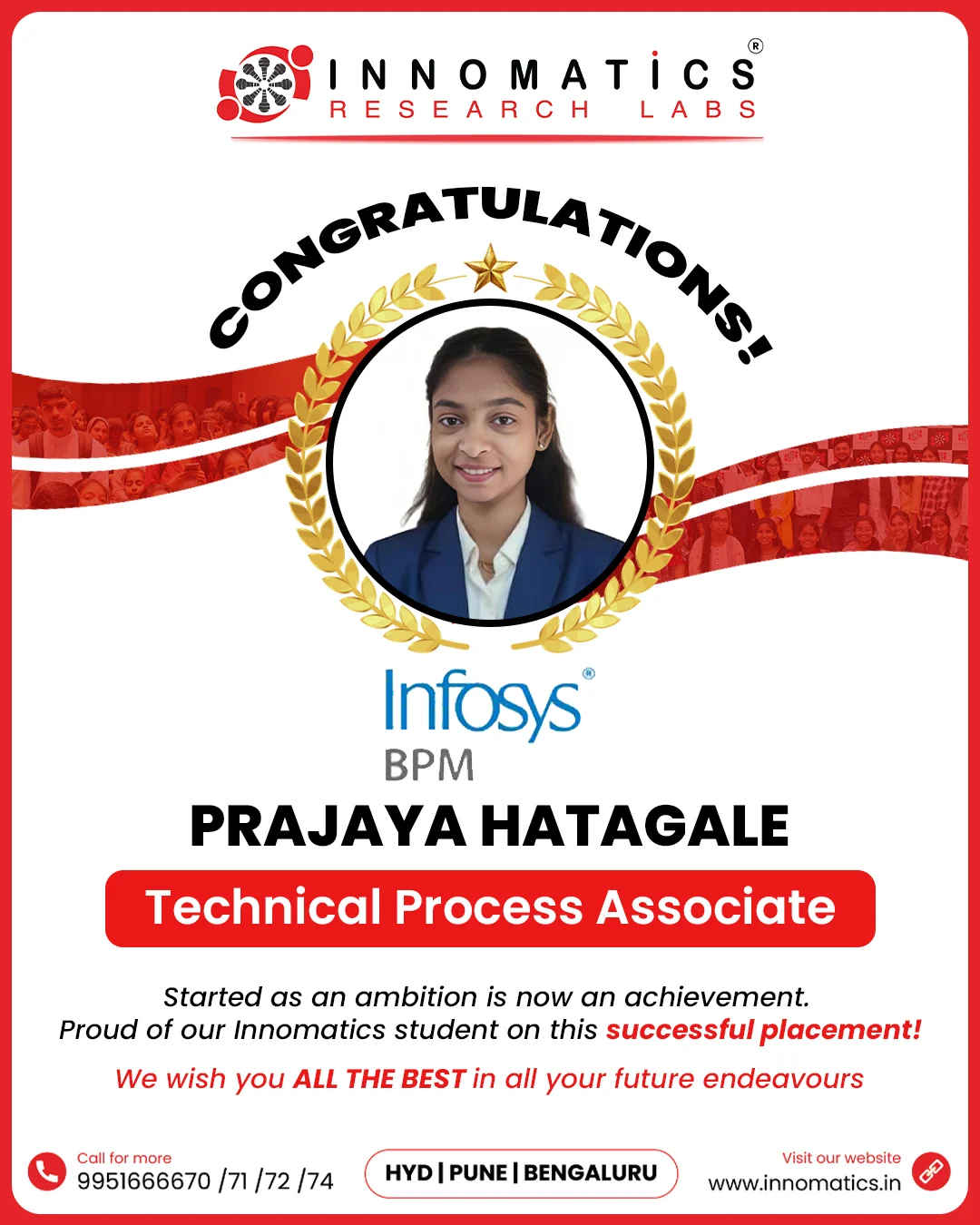


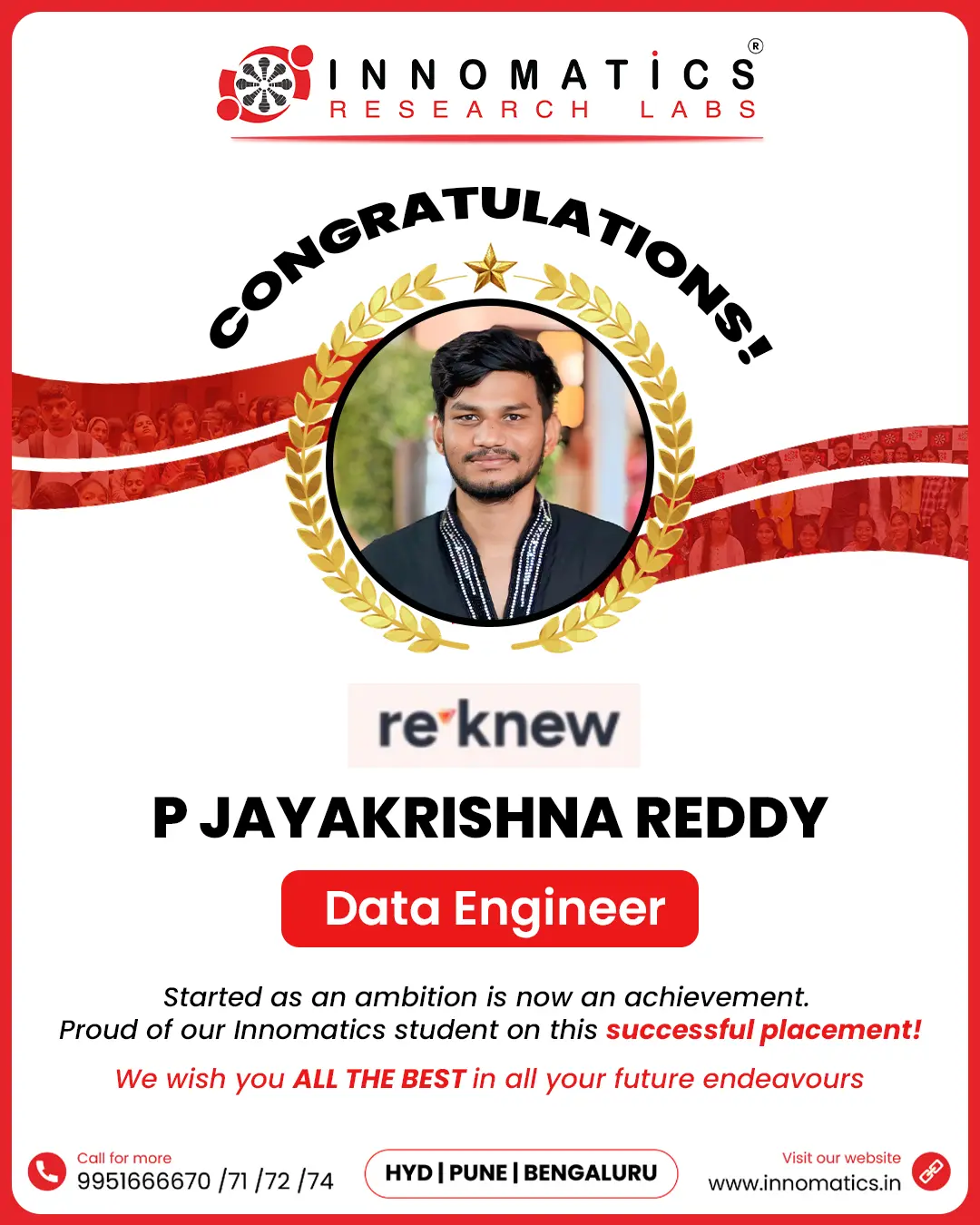


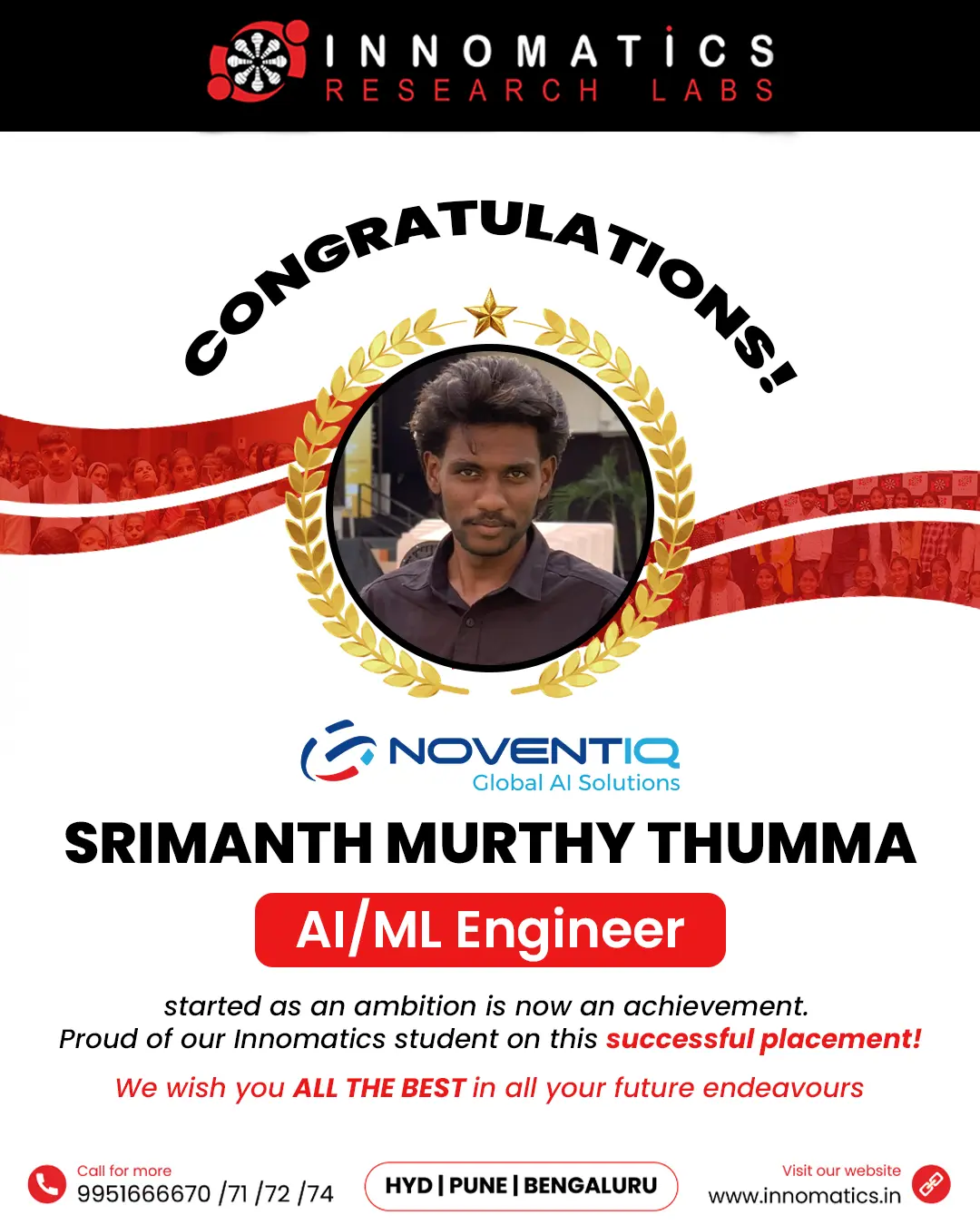
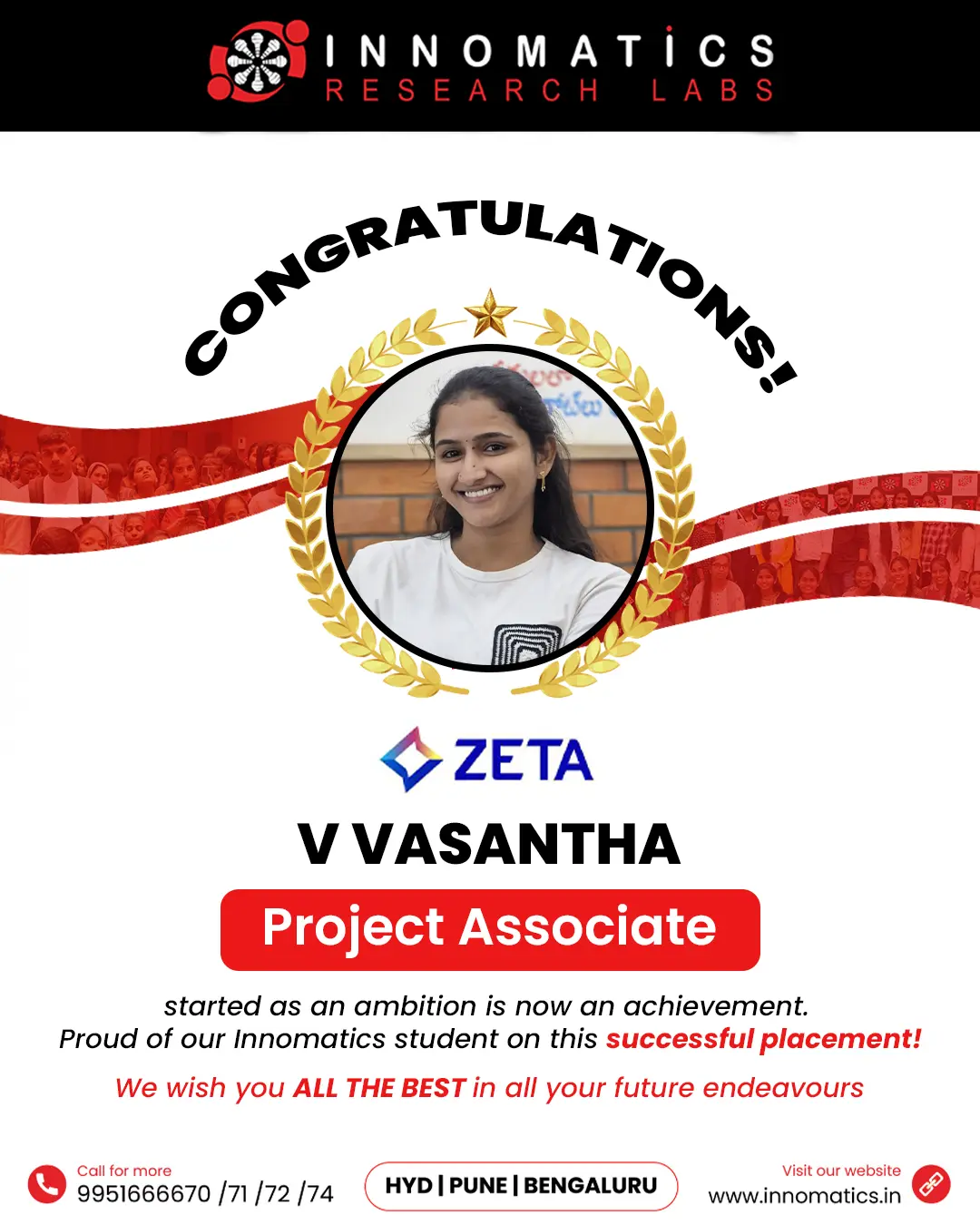
Learn What Others Don’t Teach – Only at Innomatics
 Holistic, industry-aligned curriculum covering Data Science, Full Stack Development, Data Analysis, and Generative AI using modern tools and real-world workflows
 Fragmented curriculum with limited scope, often outdated and lacking practical relevanceWell-structured, beginner-centric bootcamps designed with progressive learning paths and strong foundational supportUnstructured learning experience with minimal guidance for beginnersDeep integration of Generative AI through hands-on projects, real-world applications, and exposure to tools like ChatGPT and LLM ecosystemsSuperficial or theoretical coverage of Generative AI with limited practical exposureDiverse, career-oriented specializations including Data Science, Full Stack Development, Data Analysis, and Artificial IntelligenceGeneric specializations with little alignment to current industry demandsExtensive portfolio of real-time, industry-grade projects with complete end-to-end implementationBasic or academic-level projects with limited real-world applicabilityAdvanced capstone projects focused on solving real business challenges with measurable outcomesPredefined or limited capstone options with minimal complexityEstablished alumni network placed in leading organizations, supported by continuous career guidance and community engagementLimited alumni presence with minimal long-term career supportImmersive learning experience with 70+ case studies, live datasets, hackathons, and intensive practical sessionsReliance on pre-built datasets with reduced emphasis on hands-on practiceGuidance from industry professionals, IIT/NIT alumni, and seasoned mentors with real-world expertisePrimarily platform-driven learning with limited access to expert mentorshipHolistic, industry-aligned curriculum covering Data Science, Full Stack Development, Data Analysis, and Generative AI using modern tools and real-world workflowsFragmented curriculum with limited scope, often outdated and lacking practical relevanceWell-structured, beginner-centric bootcamps designed with progressive learning paths and strong foundational supportUnstructured learning experience with minimal guidance for beginnersDeep integration of Generative AI through hands-on projects, real-world applications, and exposure to tools like ChatGPT and LLM ecosystemsSuperficial or theoretical coverage of Generative AI with limited practical exposureDiverse, career-oriented specializations including Data Science, Full Stack Development, Data Analysis, and Artificial IntelligenceGeneric specializations with little alignment to current industry demandsExtensive portfolio of real-time, industry-grade projects with complete end-to-end implementationBasic or academic-level projects with limited real-world applicabilityAdvanced capstone projects focused on solving real business challenges with measurable outcomesPredefined or limited capstone options with minimal complexityEstablished alumni network placed in leading organizations, supported by continuous career guidance and community engagementLimited alumni presence with minimal long-term career supportImmersive learning experience with 70+ case studies, live datasets, hackathons, and intensive practical sessionsReliance on pre-built datasets with reduced emphasis on hands-on practiceGuidance from industry professionals, IIT/NIT alumni, and seasoned mentors with real-world expertisePrimarily platform-driven learning with limited access to expert mentorship
What Our Data Science Students Say About Innomatics
Data Science Career Opportunities & Job Roles After Course
Leading Careers in Data Science
Data Science opens doors to diverse career opportunities across IT, BFSI and healthcare sectors. From Data Analysis and Machine Learning to AI and Business Intelligence — skilled professionals are among the most sought-after talent in today’s job market.
- Data Scientist
- Data Analyst
- Machine Learning Engineer
- Business Intelligence Analyst
- AI/ML Developer
- Deep Learning Engineer
- Natural Language Processing NLP Engineer
- Statistical Analyst
- Data Visualisation Specialist
- Data Product Manager
Enroll Now
General Queries & Answers
Why should I consider a data science course in Bangalore?
When choosing a Data Science course in Bangalore, look for a practical, industry-aligned curriculum, hands-on projects, experienced mentors, relevant certification options, flexible learning modes, and dedicated placement assistance. Innomatics focuses on practical learning across Data Analytics, Python, SQL, Machine Learning, Artificial Intelligence, and Generative AI, with live projects and career support.
What is the fee for the Data Science course at Innomatics Bangalore?
The fee structure for Innomatics’ Data Science course in Bangalore is available upon request. Contact our counselling team for the latest batch pricing and available offers.
How long does a typical data science course in Bangalore last?
The Data Science course typically spans a few months of structured, live instruction, depending on the training track and learning pace. Both online and classroom batches are available with flexible schedules to suit working professionals and graduates. Contact our team for exact batch timelines and start dates.
Can a non-technical fresher join the Data Science course in Bangalore?
Yes. The curriculum is structured from fundamentals — covering Python, SQL, and Statistics from scratch — making it suitable for graduates from any background. No prior coding experience is required to enroll.
What kind of placement support does Innomatics provide in Bangalore?
Innomatics provides dedicated placement assistance, including resume building support, mock interview preparation, and career guidance throughout the program, backed by a strong network of industry hiring partners.