


Best Data Science Training Edtech in India
TIH at IIT Bombay / IIT Patna Certification Program
Data Analytics · Artificial Intelligence · Machine Learning · GenAI · Agentic AI
Online Training & Classroom Training
Enroll Now – Get early bird discount of 5K
Innomatics is Hyderabad’s leading Data Science course and training institute, offering expert-led programs in Data Analytics, AI, Machine Learning, GenAI, and Agentic AI. Our curriculum is aligned with NASSCOM FutureSkills Prime and the TIH at IIT Bombay/IIT Patna program, helping learners build job-ready skills through hands-on projects, real-world case studies, online & classroom training, internships, and industry-recognized certifications backed by dedicated placement support
Access to Live Class Recordings | Lifetime LMS Access | 24/7 Mentor Support
Enroll Now
TIH at IIT Bombay Certified- Advanced Data Science Curriculum
Introduction to Python Programming
- What is Python programming language?
- Why is the Python programming language required for Data Science?
- What is Anaconda?
- Installation of Anaconda
- Understanding Jupyter Notebook
- Basic commands in Jupyter Notebook
- Understanding Python Syntax
- Data Types in Python broadly discussed
Literals, Keywords and Data Types
- What is an Identifier?
- Rules for Identifier Naming
- Inbuilt Keywords
- Variables and Data Types
- print() and input()
Python Operators
- Arithmetic Operators
- Assignment Operators
- Comparison Operators (Relational)
- Logical Operators
- Identity Operators
Conditional Statement
- What are Conditional Statements?
- if Statement
- if-else Syntax
- if-elif-else
- Nested if and if-else
- elif Ladder
While Loops & While-Else
- What is a Loop?
- Why Loops are Used?
- while Loop Syntax
- Control Flow
- Solving Pattern Problems
Lists
- What is a List?
- How to Define a List?
- Accessing List Elements Using Indexing and Slicing
- Built-in Methods
- Basic Examples Using Lists to Print Elements at Even Index, etc.
Tuple & Set
- What is a Tuple?
- How to Create a Tuple?
- Accessing Tuple Elements Using Indexing and Slicing
- Differences Between Lists and Tuples
- What is a Set?
- How to Create a Set?
- Built-in Methods
- Set Operations
- Manipulating and Accessing Sets
Dictionary
- What is a Dictionary?
- How to Create a Dictionary?
- Adding, Modifying and Retrieving Values from a Dictionary
- Getting All Methods
- Built-in Methods
- Differences Between Sets and Dictionaries
- Mutable vs Immutable Data Types
Strings
- What is a String?
- Create a String
- Accessing a String Using Indexing and Slicing
- Built-in Methods
- format() Method
- User Input / Dynamic Entry
- Type-Casting of Strings
For Loop, For-else & Comprehension
- Introduction to for Loop, range(), enumerate()
- For-else
- List Comprehension & Dictionary Comprehension
- Problem Solving with Respect to String Methods Utilizing for Loops & Conditional Statements Making Use of chr() and ord()
- Problem Solving with List and Dictionary
- Comprehension
Functions
- What is a Function?
- Why Functions are Used?
- Terminologies Used in Functions
- How to Define a Function?
- How to Call a Function?
- Positional and Keyword Arguments
Higher Order Functions
- Functions with/without Return Values
- Lambda Functions
- Map, Filter & Reduce
- Name Spaces
- Modules and Package
- Using Conditional Statements
- Using Loops
- Using Functions
Modules & Packages
- Modules and Package
- Date Time
- Random
- math, os
- Creating Custom Module
OOPS - Classes and Objects
- What is a Class?
- How to Create a Class?
- What are the Properties and Methods of a Class?
- What is an Object?
- How to Create an Object?
- How to Access the Properties and Methods of a Class Using an Object?
- What is a Constructor?
- What are the Types of Variables?
- What are the Types of Methods?
- Access Modifiers
Inheritance & Abstraction
- Inheritance
- Single Inheritance
- Multilevel Inheritance
- Multiple Inheritance
- Hierarchical Inheritance
- Hybrid Inheritance and MRO
- Abstraction
Polymorphism and Encapsulation
- Polymorphism
- Dynamically Typed or Duck Typing
- Operator, Method and Constructor Overloading
- Method and Constructor Overriding
- Encapsulation
- Setter and Getter
File Handling & Exception Handling
- What is a File?
- How to Create a File?
- How to Open a File?
- How to Close a File?
- Writing to a File
- Appending to a File
- Reading from a File
- Testing File's Existence
- What is an Exception?
- Raising Exceptions
- try-finally
- Custom Exceptions
VS Code & Streamlit Deployment
- What is Streamlit?
- Components of Streamlit
- Creating an Application with Streamlit
- VS Code, Setting Environment
- Executing Programs in VS Code
Backend with FastAPI
- Client-Server Architecture
- Introduction to FastAPI
- Request Methods
- Hands-on FastAPI
- Application Building
- Integration of FastAPI with Streamlit
- Case Study
GenAI: Enhanced Coding Fundamentals
- Introduction to AI-Assisted Coding
- ChatGPT for Code Generation and Explanation
- AI-Assisted Debugging and Code Optimization
- Generating Python Solutions with ChatGPT
- Hands-on AI-Assisted Coding for Data Science Tasks
Introduction to EDA
- How is EDA different from Python programming?
- EDA vs Python with Case Study
- Types of Data (Numerical, Categorical)
- Types of Analysis (Non-Visual and Visual, Univariate and Bivariate, Descriptive, Inferential & Probabilistic)
Descriptive Statistics
- What and Why Statistics?
- Data and its Measures
- Measures of Central Tendency (Univariate Analysis)
- Measures of Dispersion (Univariate Analysis)
- Measures of Correlations (Bivariate Analysis)
Core Numpy Operations
- Generating Random Numbers - np.random.rand, np.random.randn, np.random.randint, np.random.uniform
- Indexing and Slicing of Arrays (1D & 2D)
- Indexing with Boolean Arrays
- Updating Numpy Array
- Insert, Append and Delete
- Array Shape Manipulations - reshape, ravel and flatten, transpose
- Problem Solving
Mathematical & Statistical Functions
- Iterating over a 1D and 2D Numpy Array
- Iteration Using np.nditer()
- Python Operators on Numpy Array
- Numpy Maths - sqrt(), exp(), sin(), cos(), add(), subtract(), multiply(), divide(), dot(), @ Operator
- Numpy Statistics - sum(), min(), max(), mean(), median(), var(), std(), corrcoef()
Vectorization and Advanced Numpy Functions
- Array Manipulations - Concatenate, vstack, hstack, column_stack, hsplit, vsplit
- Sorting the Data in an Array - sort, argsort
- Broadcasting Arrays
- Numpy where, any
Introduction to Pandas
- Introduction to Pandas
- Pandas Series
- Pandas DataFrame
- Difference Between Series and DataFrame
- Creating Series and DataFrames
Data Exploration and Understanding
- Loading Data from CSV and Excel Files
- Understanding the DataFrame Structure
- DataFrame Non-Indexing Attributes
- DataFrame Utility Methods
- DataFrame Iteration Methods
- Mathematical Functions on Whole DataFrame
- Getting Column Index/Label
- Changing Column Labels
- Selecting, Swapping Columns
- Adding New Columns / Dropping Existing Columns
- Vectorized Arithmetic Operations
- Data Type Conversions
- Math and Statistical Functions on Columns
Groupby and Pivot on DataFrame
- Summarizing Data Using groupby()
- Multidimensional Aggregation Using pivot_table()
- Categorical Analysis Using crosstab
Working With Multiple Tables Using Joins (Merge Operation)
- Concatenation - Vertical and Horizontal Stacking
- Merging (merge) - Inner, Outer, Left and Right Joins
- Index-Based Merging
Handling Missing Values, String and Datetime Manipulations
- Types of Missing Data
- Identifying and Visualizing Missing Data
- Missing Value Imputation
- String Operations
- Working with Datetime
Advanced Data Transformations
- apply() and map()
- Window Functions (rolling(), expanding())
- Handling JSON Files
- JSON record_path Normalization
Univariate and Bivariate Statistical Analysis (Non-Visual)
- Measures of Shape
- Measure of Relationship
- With a Case Study - Descriptive Stats
Introduction to Data Visualization
- Understanding Visualization
- Basic Structure of a Plot - Figure, Axis, Title, Legends, Ticks, Labels, Subplots
- Creating Basic Plots with Raw Data
- Customizing the Plots - Colormaps, Axis Limits, Markers, Linestyles, Colors
Univariate Analysis with Matplotlib/Seaborn
- Univariate Plots for Numeric Data - Histogram, KDE, Boxplot, Violinplot
- Univariate Plots for Categorical Data - Barplot, Countplot
Bivariate and Multivariate Analysis with Matplotlib/Seaborn
- Plots Between Numerical Variables - Scatterplot, Heatmap, Lineplot
- Plots Between Categorical Variables - KDE Plot, Boxplot, Histogram, Boxenplot, Violinplot
- Plots Between a Numeric and a Categorical Variable - Countplot, Stacked Barplot
- Plots for Multivariate Analysis - Pairplot, Heatmap
Interactive Data Visualization with Plotly
- Interactive Plots for Numeric Data - Histogram, Boxplot, Violinplot, Densityplot
- Interactive Plots for Categorical Data - Bar Chart, Grouped Bar Chart, Pie Chart, Funnel Chart
- Interactive Plots for Bivariate Analysis - Scatterplot, Line Chart, Bubble Chart, Area Chart
- Interactive Plots for Multivariate Analysis - Heatmap, Scatter Matrix, Parallel Coordinates
- Advanced Plotly Visualizations - Subplots, Animations, Hover Interactions, Filters
Introduction to Probability
- Random Experiment
- Sample Space
- Event
- Axioms of Probability
- Basic Probability Examples
Frequency Tables
- Introduction to Frequency Tables
- Joint Probability
- Marginal Probability
- Conditional Probability
Introduction to Data Distributions, Discrete Data Distributions
- What is a Data Distribution?
- Why Study Data Distribution?
- Key Characteristics
- Types of Distributions
- Introduction to SciPy Library
- Bernoulli, Binomial, and Poisson
Continuous Data Distribution
- Uniform, Normal
- Exponential
- Log Normal
- Pareto Distribution
- 68-95-99.7% Rule
- Verify the Distribution Using QQ Plot
Feature Engineering
- Feature Scaling - Normalization and Standardization
- Data Transformation
- Log Transformation and Box-Cox
Introduction to Inferential Statistics
- Inferential Statistics
- Population vs Sample
- Why Inferential Statistics?
- Sampling Techniques - Convenience Sampling, Systematic Sampling, Simple Random Sampling, Stratified Sampling, Cluster Sampling
- Sampling in Pandas DataFrame
Central Limit Theorem and Point Estimate
- Performing Estimations
- Point Estimate Using Single Sample
- Central Limit Theorem
- Point Estimate Using m Samples
Confidence Interval Estimate
- Confidence Interval Estimates Using 1 Sample (Population Std is Known and Unknown)
- Confidence Level
- Significance Level
- Critical Value - z-score and t-score
Hypothesis Testing and Advanced Statistical Tests
- What is Hypothesis Testing?
- What is p-value?
- Important Hypothesis Tests
- Type I and Type II Errors
- Parametric and Non-Parametric Tests - Chi-Square Test, ANOVA
Simplifying Statistical Analysis with AI Tools
- Introduction to AI-Assisted Statistical Analysis - Role of GenAI in Statistics
- AI-Assisted Descriptive Statistics - Mean, Median, Mode, Variance and Standard Deviation
- AI-Assisted Statistical Analysis - Correlation, Distribution and Hypothesis Testing
- Interpreting Statistical Results with GenAI - Insights and Explanations
- Hands-on with AI Tools - Statistical Analysis and Interpretation
Regular Expressions
- Pattern Matching Basics
- Email, Phone Number & URL Extraction
- Text Cleaning & Data Validation
- Removing Special Characters
- Regex with Python (re module)
Ethical Web Scraping
- Requests Library
- BeautifulSoup
- HTML Parsing
- CSS Selectors & Inspect Element
- Extracting Tables, Text & Links
- Pagination Handling
Data Cleaning & Preprocessing
- Handling Missing Values
- Removing Duplicates
- String Cleaning
- Formatting & Standardization
- Data Transformation Using Pandas
Exploratory Data Analysis (EDA)
- Data Understanding & Profiling
- Statistical Summary
- Data Visualization Using Matplotlib & Seaborn
- Correlation & Trend Analysis
- Business Insights Generation
Project on EDA
- Collect Real-Time Data from Websites Ethically
- Clean and Preprocess Raw Datasets
- Apply Regex for Data Extraction & Validation
- Perform EDA and Generate Insights
- Build Industry-Oriented Projects
GenAI: Powered Data Wrangling with PandasAI
- Introduction to Data Wrangling - Data Cleaning, Transformation, Integration
- Introduction to PandasAI - AI-Assisted Data Manipulation
- AI-Powered Data Cleaning - Missing Values, Duplicates, Data Types
- AI-Assisted Data Transformation - Filtering, Sorting, Aggregation
- Natural Language Data Analysis - Querying and Exploring Data with PandasAI
Introduction to SQL
- Data
- What is Database?
- DBMS
- RDBMS
- SQL vs MySQL
- SQL vs NoSQL
- CRUD Operations
- Pandas vs SQL
- Client-Server Architecture
- Workbench Introduction
SQL Fundamentals
- Types of SQL Commands
- Data Types
- Constraints (PRIMARY KEY, AUTO_INCREMENT, NOT NULL, UNIQUE, DEFAULT, CHECK)
- Creating Tables with Constraints
- DDL (CREATE, ALTER, DROP, TRUNCATE)
- DML (INSERT, UPDATE, DELETE)
Multiple Tables
- Multiple Tables - Primary Key, Composite Key, Foreign Key
- Types of Relationships in SQL
- ER Diagram
- Case Study: On Relational Database
Data Exploration and Data Filtering (DQL and Operators)
- SELECT (Retrieve)
- Data Exploration - Selecting Columns; Performing LIMIT, DISTINCT, Aggregation Values, Indexing and Slicing Using OFFSET
- Data Filtering - Filtering Data Based on Conditions (with All Operators: LIKE, REGEXP, BETWEEN)
- GROUP BY (Aggregate Function)
- HAVING (Correlating with get_group in Pandas)
- ORDER BY
- CASE
- Order of Execution
- Case Study: A Case Study of Clauses
Joins, Unions and Subquery
- Types of Joins - INNER JOIN, Outer Join (LEFT, RIGHT), CROSS JOIN, SELF JOIN
- Set Operations - UNION, UNION ALL
- Subquery - Scalar Subquery, Multiple Subquery, Correlated Subquery
Temporary Tables
- Derived Table
- CTE
- Inbuilt Functions
- Window Functions
- Case Study: A Case Study of Temporary Tables
SQL Database Objects
- Views
- Stored Procedure
- Functions
Advanced Topics
- Transaction Control Language - ACID Properties, COMMIT, ROLLBACK, SAVEPOINT
- Triggers
- Type Conversion, Working with Date, Time & String Functions
- Connectivity of MySQL with Python (Pandas)
Project on MySQL
- Analyze normalized relational databases and ER diagrams based on real-world business requirements
- Import and manage CSV datasets in SQL databases
- Write SQL queries using filters, aggregations, sorting, and joins
- Develop advanced SQL solutions using CTEs, Views, Stored Procedures, and Window Functions
- Solve domain-specific business problems and generate actionable insights
GenAI-Powered SQL: Query Generation & Optimization
- Introduction to AI-Powered SQL - AI-Assisted SQL Concepts and Workflows
- AI-Assisted Query Generation - Natural Language to SQL
- AI-Assisted Query Optimization - Query Performance and Optimization
- SQL Debugging with GenAI - Error Identification and Correction
- Hands-on with AI-Powered SQL - Query Generation and Optimization
Excel Essentials for Data Analysis
- Introduction to Excel for Data Analysis
- Data Exploration Using Excel Functions
- Data Cleaning and Formatting in Excel
- Sorting, Filtering and Data Validation
- Conditional Formatting and Data Highlighting
- Lookup Functions: VLOOKUP, XLOOKUP and INDEX-MATCH
- Pivot Tables and Pivot Charts for Data Analysis
- Advanced Excel Functions for Data Analysis
- Case Study: Dash-boarding in Excel
Introduction to Power BI
- What is Business Intelligence?
- Power BI Introduction
- Quadrant Report
- Comparison with Other BI Tools
- Power BI Desktop Overview
- Power BI Workflow
Data Import and Data Visualizations
- Data Import Options in Power BI
- Import from Web (Hands-on)
- Why Visualization?
- Visualization Types
- Categorical Data Visualization
- Trend Data Visualization
Power Query
- Power Query Introduction
- Data Transformation - Its Benefits
- Introducing Ribbons
- Queries Panel
- M Language Briefing
- Power BI Data Types
- Changing Data Types of Columns
- Filtering
- Inbuilt Column Transformations
- Inbuilt Row Transformations
- Combine Queries
- Merge Queries
Power Pivot and Introduction to DAX
- Power Pivot
- Introduction to Data Modeling
- Relationship and Cardinality
- Relationship View
- Calculated Columns vs Measures
- DAX Introduction and Syntax
Data Analysis Expressions
- DAX Logical Functions
- DAX Text Functions
- DAX Math and Statistical Functions
- DAX Aggregation Functions
- DAX Filter Functions
- DAX Time Intelligence Functions
- Creating a Date Dimension Table
- Related Aspects with Tables
Login, Publish to Web and RLS
- Power BI Services
- Dashboard Creation
- Web Content, Image, Text Box
- Dashboard Formatting
- Sharing Your Dashboard
- RLS Introduction
Miscellaneous Topics
- Visual Interactions
- Drill Through
- Drill Down
- Conditional Formatting
- Creating Buttons in Power BI Reports
- Creating Python Script Visuals
Project on Power BI
- Understand business problems and define reporting objectives
- Load data from multiple sources into Power BI
- Clean and transform data using Power Query
- Build data models and establish relationships
- Create DAX measures and calculated columns
- Design interactive dashboards and reports
- Generate insights and business recommendations across multiple industry domains
GenAI: Enhanced Presentations with ChatGPT
- Introduction to AI-Enhanced Presentations - Role of GenAI in Data Storytelling
- AI-Assisted Content Creation - Insights, Summaries and Key Takeaways
- AI-Assisted Presentation Design - Structure, Visuals and Slide Content
- Data Storytelling with ChatGPT - Converting Analysis into Narratives
- Hands-on with ChatGPT - Creating Data-Driven Presentations
Machine Learning Foundations
- Why Machine Learning?
- AI vs ML vs Deep Learning
- Supervised vs Unsupervised Learning
- Regression vs Classification
- Machine Learning Workflow / Lifecycle
Problem Definition & Objective
- Business Problem Statement
- Defining ML Objectives
- Identifying Features and Target
- Identifying Regression or Classification Tasks
Feature Engineering
- Feature Transformation
- Feature Selection
- Feature Importance
Train-Test Split
- Training and Testing Data
- Importance of Data Splitting
- Avoiding Data Leakage
Numerical Data Preprocessing
- Numerical Feature Preprocessing
- Feature Scaling
- Types of Feature Scaling
- Standardization
- Normalization
Categorical Data Preprocessing
- Categorical Feature Preprocessing
- Encoding Techniques
- One-Hot Encoding
- Ordinal Encoding
Supervised Learning - Classification Algorithms
- Introduction to Classification
- K-Nearest Neighbors (KNN)
- Logistic Regression
- Naive Bayes
- Decision Tree
Supervised Learning - Regression Algorithms
- Introduction to Regression
- Linear Regression
- KNN for Regression
- Decision Tree for Regression
Data Collection
- Data Sources
- Data Collection Methods
- Loading and Understanding Datasets
Exploratory Data Analysis (EDA)
- Univariate, Bivariate and Multivariate Analysis
- Visual and Non-Visual Statistics
- Understanding Data Distributions and Relationships
Data Quality Assessment
- Identifying Duplicates
- Handling Null and Missing Values
- Detecting Outliers
- Data Type and Consistency Checks
Model Building with Scikit-learn
- Model Training and Prediction
- Applying Preprocessing and Models
- Building ML Pipelines
- Hands-on Model Implementation
Regression Evaluation Metrics
- Mean Absolute Error (MAE)
- Mean Squared Error (MSE)
- Root Mean Squared Error (RMSE)
- R² Score
- Adjusted R² Score
Classification Evaluation Metrics
- Confusion Matrix
- Accuracy, Precision and Recall
- F1 Score
- Classification Report
Hyperparameter Tuning
- Parameters vs Hyperparameters
- Introduction to Cross-Validation
- GridSearchCV
- RandomizedSearchCV
- Model Selection and Tuning
GenAI: Enhanced Machine Learning Case Study
- Problem Definition & Data Understanding - Problem Statement, Objectives and AI-Assisted Data Exploration
- EDA & Data Preparation - AI-Assisted EDA, Data Cleaning and Feature Engineering
- Model Building & Evaluation - AI-Assisted Model Selection, Training and Evaluation
- Model Optimization & Interpretation - AI-Assisted Hyperparameter Tuning and Result Interpretation
- Business Insights & Deployment - AI-Assisted Insights and Reporting
GenAI Fundamentals for Data Analysts
- Introduction to Generative AI
- Generative AI vs Traditional AI
- Applications of GenAI in Data Analytics
- Overview of GenAI Tools - ChatGPT, Gemini, Gamma
Understanding LLMs
- What are Large Language Models?
- Context, Prompts and Responses
- Data Relevance and Hallucinations
- Limitations of LLMs
Prompt Engineering Essentials for Data Analytics
- Introduction to Prompt Engineering
- Effective Prompt Structure
- Context, Role and Constraints
- Iterative Prompting and Refinement
Prompting for Data Tasks
- Prompts for Data Understanding
- Prompts for Data Cleaning and EDA
- Prompts for Data Interpretation
GenAI for Data Cleaning & EDA
- AI-Assisted Data Understanding
- Identifying Missing Values, Duplicates and Outliers
GenAI for Code & SQL
- AI-Assisted Python Code Generation
- Code Explanation and Debugging
- AI-Assisted SQL Query Generation
- Query Optimization and Validation
GenAI for Analytics Reporting
- Converting Analysis into Insights
- AI-Assisted Report, PPT and PDF Generation using ChatGPT
- Data Storytelling with GenAI
- Creating Presentations with Gamma
Multimodal GenAI for Data Analytics
- Understanding Text, Images and Tables with GenAI
- Extracting Information from Documents and Images
- Image and Chart Interpretation
- Multimodal Analysis with ChatGPT and Gemini
Automating Data Analytics Workflows
- Introduction to AI-Assisted Automation
- Automating Repetitive Analytics Tasks
- Connecting Data and GenAI Tools
- Workflow Design with GenAI
No-Code AI Automation with n8n
- Introduction to n8n
- Connecting AI Models with Data Sources
- Building AI-Assisted Analytics Workflows
- Automating Reports and Notifications
Responsible GenAI for Data Analytics
- AI Limitations and Hallucinations
- Data Privacy and Security
- Bias and Responsible AI Usage
- Human Validation and Oversight
GenAI: Enhanced Data Analytics Case Study
- Problem Definition and Data Understanding
- AI-Assisted EDA and Data Preparation
- AI-Assisted Analysis, Reporting and Visualization
- Workflow Automation using GenAI Tools
- Validating AI Outputs and Generating Business Insights
GenAI Tools & Future of Data Analytics
- Comparing GenAI Tools for Data Tasks
- Selecting the Right Tool for the Task
- Building Personal GenAI Workflows
- Staying Current with Emerging GenAI Tools
Ethics, Responsibility & Staying Current with GenAI
- AI Ethics, Bias and Responsible AI Usage
- Data Privacy, Security and Intellectual Property
- Hallucinations, Human Validation and AI Reliability
- Staying Current with Emerging GenAI Tools and Technologies
Synthetic Data & Image Generation
- Introduction to Synthetic Data Generation
- Generating Synthetic Data for Testing and Analysis
- Introduction to AI-Based Image Generation and Use Cases
Projects & Case Studies
- Retail Sales Analysis
- Student Performance Analysis
- PeopleOps Analytics
- HR Analytics - Employee Attrition & Performance Analysis
- Pricing Strategy Analysis
- AI-Augmented Business Intelligence
Text Preprocessing
- Text Data - Introduction to NLP
- Why Text Data is Hard to Work With
- Cleaning Text Data
- Tokenisation
- Stop Words
- Lemmatization
- Stemming
Text Transformation
- Bag of Words
- Term Frequency-Inverse Document Frequency (TF-IDF)
- Spam-Ham Detection
Working with Image Data
- Image Data - Understanding Images
- RGB Channels
- Images as 3D NumPy Arrays
- Image Case Study
Mathematical Foundations
- Introduction and Why Linear Algebra
- Fundamentals of Vectors and Matrices
- Unit Vector
- Matrix Operations
- Dot Product of Vectors
- Angle Between Two Vectors
- Projection of a Vector onto Another Vector
- Length of Projection
- Distances and Dot Products
kNN for Classification & Regression
- Intuition Behind KNN
- Developing the Algorithm for KNN
- Solving Classification Problems with KNN
- Solving Regression Problems with KNN
- Code Implementation for KNN
- Hyperparameter Tuning
Naive Bayes Derivation, Solving an Example with NB
- Derivation of Naive Bayes Algorithm
- Solving an Example
- Code Implementation
- NB Example
Decision Tree (DT) Algorithm
- Introduction to Rule-Based Approach to Solve Classification and Regression Problems
- Building Decision Trees
- ID3, C4.5, C5.0 Algorithms to Build Decision Trees
- Concept of Entropy, Information Gain and Gini Impurity
- Python Code Sample
DT for Classification and Regression
- Working of DT with Numerical Input Data
- DT for Regression
- Reduction of Variance
- Solving an Example with DT
Equation of Line and Linear Regression, Multiple Linear Regression
- Understanding Equation of a Line and Hyperplane
- Intuition Behind Linear Regression
- Building a Cost Function for Regression and Classification Problems
- Mathematical Formulation of Linear Regression
- Calculating the Errors
- Python Implementation
- Simple Linear Regression vs Multiple Linear Regression
- Issues with Multiple Linear Regression
- Python Implementation
- Issue of Multicollinearity
- Detecting Multicollinearity with VIF
Linear Regression Edge Cases
- Linear Regression with Polynomial Features
- Assumptions of Linear Regression
- Hands-on
Gradient Descent
- Understanding Differentiation of a Function
- Slope of Tangent
- Computing Derivative
- Computing Maxima and Minima
- Iterative Algorithm to Solve the Problem of Maxima and Minima
- Update Function of Gradient Descent
Logistic Regression
- Geometric Intuition Behind Logistic Regression
- Mathematical Formulation of Logistic Regression
- Signed Distance Formulation
- Sigmoid Function
- Numerical Instability Issue
- Assumptions of Logistic Regression
- Code Sample
Support Vector Machines
- Introduction to SVM
- Solving Classification Problems Using SVM
- Logistic Regression vs SVC
- Margin Maximization
- Hard Margin Support Vector Classifier
- Soft Margin Support Vector Classifier
- How Kernel Trick Works?
- Pros and Cons of SVC
Parallel Ensembles
- Introducing Model Ensembles
- Voting Ensembles
- Stacking
- Bagging - Random Forest Case Study
Sequential Ensembles
- Cascading
- Boosting
- AdaBoost
- GBDT
- XGBoost Case Study
Feature Engineering - Transformation & Selection
- Revision on Feature Transformation
- Feature Selection Introduction
- Variance Thresholding
- Variance Inflation Factor
- Recursive Feature Elimination
- Lasso Regularization
- Decision Tree for Feature Importance
- Implementation Using Python
Introduction to Unsupervised Learning and KMeans, KMeans++
- Understanding Unsupervised Learning
- Clustering
- Applications of Clustering
- K-Means Algorithm
- Python Code Sample
- KMeans++ Initialisation
Hierarchical Clustering, Customer Segmentation
- Introduction to Hierarchical Clustering
- Merging
- Linkage - Single, Centroid, Complete
- Dendrogram
- Cut Tree
- Solving Customer Segmentation Using Clustering
PCA and Use Case
- Introduction to Dimensionality Reduction
- Introduction to Principal Component Analysis
- Eigenvalues and Eigenvectors
- Orthogonality
- Transforming Eigenvalues
- Proportion of Variance Explained in PCA
- Code Implementation
Time Series Forecasting
- Introduction to Time Series Data
- Components of Time Series - Trend, Seasonality & Residuals
- Time Series Analysis and Visualization
- Time-Based Train-Test Split
- Introduction to Forecasting
- Forecasting with Machine Learning
- Model Evaluation for Time Series Forecasting
- Hands-on Time Series Forecasting Case Study
AutoML & GenAI-Assisted Modeling
Exclusively for ✳ TIH at IIT Bombay
- Introduction to AutoML
- Automated Data Preprocessing, Feature Engineering & Model Selection
- Introduction to GenAI-Assisted Machine Learning
- AI-Assisted Model Selection, Code Generation & Debugging
- AI-Assisted Model Interpretation and Insights
- Hands-on AutoML & GenAI-Assisted Modeling
Explainable AI: Model Interpretation with LIME & SHAP
Exclusively for ✳ TIH at IIT Bombay
- Introduction to Explainable AI (XAI) and Model Interpretability
- Importance of Model Interpretation in Machine Learning
- Global vs Local Model Interpretability
- Model Interpretation using SHAP (SHapley Additive exPlanations)
- Model Interpretation using LIME (Local Interpretable Model-Agnostic Explanations)
- Feature Importance and Prediction-Level Explanations
- Interpreting and Communicating Model Insights
- Hands-on LIME & SHAP Model Interpretation Case Study
Project on Machine Learning
- Understand business problems and define clear machine learning objectives
- Collect and integrate datasets from multiple sources or publicly available repositories
- Perform data cleaning, preprocessing, and feature engineering
- Conduct Exploratory Data Analysis (EDA) to identify trends, patterns, and relationships
- Prepare training, validation, and testing datasets using appropriate data-splitting strategies
- Build and train supervised and unsupervised machine learning models
- Evaluate model performance using appropriate evaluation metrics
- Optimize models using hyperparameter tuning and cross-validation
- Apply LIME and SHAP for model interpretability and explainable AI
- Interpret model predictions and translate findings into actionable business insights
- Implement MLOps practices using MLflow for experiment tracking and model management
- Track model parameters, metrics, versions, and training workflows
- Deploy machine learning applications using Streamlit
- Develop end-to-end ML pipelines for practical and scalable real-world applications
Introduction to Deep Learning and Artificial Neural Networks
- Understanding Biological Neuron
- Analogy between Biological and Artificial Neuron
- Single Layer Perceptron Model
- Understanding Weights, Bias and Activation
Perceptron Model
- Perceptron Learning Rule
- Artificial Neuron
- MLP / FCNN / ANN Model
- Nomenclature of ANN
Training Neural Network
- Forward Pass with Formulation
- Backward Pass (Without Formulation)
- Understanding Backpropagation Algorithm Using AutoGrad Methods like GradientTape in TensorFlow
ANN Model Building
- Classification Model Building Using TensorFlow / Keras
- Regression Model Building Using TensorFlow / Keras (As an Assignment)
- Evaluating Model
Neuron Activation Function and Output Functions
- Linear Activation
- Sigmoid Function
- Tanh Function
- ReLU Function (LeakyReLU, Parametric ReLU)
- Softmax Function
Optimizers
- Gradient Descent
- Mini-Batch Gradient Descent
- Momentum-Based Gradient Descent
- Adaptive Gradient Descent
- Adam
- RMSProp
Overfitting in ANN
- L1 and L2 Regularization
- Dropout Regularizer
- Early Stopping
- Batch Normalization
Hyperparameter Tuning in ANN
- Introduction to Optuna
- Creating a Study in Optuna
- Finding Hyperparameters Using Optuna
- Hyperparameter Importance Using Optuna
Project on ANN
- Understand business problems and define machine learning objectives.
- Collect datasets from multiple sources or work with publicly available datasets.
- Perform data cleaning and preprocessing.
- Split data into training, validation, and testing datasets.
- Build supervised ANN models.
- Evaluate model performance using appropriate metrics.
- Optimize models using hyperparameter tuning.
- Track model metrics, parameters, versions and training workflows.
- Interpret model outputs and generate actionable business insights.
- Deploy machine learning applications using Streamlit.
- Create end-to-end ML pipelines for scalable real-world applications.
Introduction to Text and its Preprocessing with NLTK or SpaCy
- Introduction to NLP
- Text Preprocessing Steps
- Bag of Words (BOW) and TF-IDF
- Coding for BOW and TF-IDF using NLTK / SpaCy
Word Embeddings - Word2Vec
- Word2Vec
- Autoencoders
- How Word2Vec algorithm works (CBOW, Skip-gram)
Case Study - Text Classification
- Text Data Classification Case Study
Sequence Modelling with RNN
- Introduction to RNN
- Training of RNN
- Types of RNN
- Text Classification
LSTM, GRU
- Limitations of RNN
- Idea of LSTM and GRU
- POS Tagging
Self Attention and Transformers - Seq2Seq Architecture
- Attention Mechanism
- Implementing Attention Layers
- Hands-on: RNN / LSTM + Attention
- Case Study: Machine Translation
Transformer Architecture
- Positional Encoding
- Self and Multi-Head Attention
- Masked Multi-Head Attention
- GPT with Autoregressive Language Modelling
- BERT with Auto-Encoding Language Modelling
Hugging Face API
- Introduction to Hugging Face
- Hugging Face Embeddings
- Case Study: Sentiment Analysis, Named Entity Recognition, Parts of Speech Tagging, Question & Answering
NLP Tasks using AutoClasses
- AutoClasses - Config, Tokenization and Models
Text Generation & Question Answering
- Text Summarization
- Text Translation
Evaluation Metrics
- Introduction to Evaluation Metrics
- BLEU
- ROUGE
- METEOR
- Perplexity
Hugging Face for Image and Audio Data
- Image Classification
- Image Detection
- Audio Classification
Project on Natural Language Processing (NLP)
- Understand real-world text analytics problems and define NLP objectives.
- Collect textual datasets from multiple sources or use publicly available datasets.
- Perform text cleaning, tokenization, stemming, and lemmatization.
- Convert text into numerical representations using TF-IDF, Word Embeddings, and basic transformer pipelines.
- Build NLP models for tasks such as Sentiment Analysis, Text Classification, Spam Detection, and Chatbots.
- Train and evaluate NLP models using appropriate performance metrics.
- Extract insights from unstructured textual data.
- Deploy NLP applications using Streamlit.
- Build scalable NLP solutions for real-world business use cases.
Introduction to LangChain
- Why LangChain?
- Import Chat Models
- Integrating with OpenAI / Gemini / Groq API
- LCEL Chain
Components of a Chain
- PromptTemplate
- ChatPromptTemplate
- SystemMessage, HumanMessage & AI Messages
LCEL Chain
- OutputParser - StrOutputParser, PydanticParser
- Build a Basic ChatBot
Runnables
- RunnablePassthrough
- RunnableParallel
- Runnable
- Case Study
Conversation Memory
- Adding Memory to LangChain Applications
- Context Window Optimization
- Conversation Summarization Techniques
Monitoring and Observability
- Introduction to Monitoring and Observability
- Observability Tools
- Tracing Implementation
RAG Fundamentals
- What is RAG? and Why RAG?
- Document Loaders (PDF, Web, CSV)
- Text Splitters & Chunking
Embeddings and Vector Database
- Introduction to Vector Databases
- Working with Vector Databases - FAISS, Pinecone, Weaviate
- Storing, Indexing and Retrieving Vector Embeddings
- Vector Stores
- Vector Embeddings
- Retrieval Chain
Hybrid RAG
- Keyword, Semantic and Hybrid Search
- Re-ranking
- Embedding Models & Similarity Measures
- Semantic Search using Vector Embeddings
- Metadata Filtering for Context-Aware Retrieval
- Combining Metadata Filtering with Hybrid Search
Exclusively for ✳ TIH at IIT Bombay
RAG Evaluation
- RAGAS Evaluation
- LLM-as-a-Judge
- End-to-End RAG Pipeline Architecture
- Building Production-Ready RAG Applications
- RAG with Multiple Data Sources and Documents
Exclusively for ✳ TIH at IIT Bombay
Tool Calling & Agents
- ReAct Loop
- Build a ReAct Agent using Create Agent
- Add Custom Tools (like Search and Wikipedia)
- Response Formatting
- Error Handling
- Memory with Checkpointer
- PII Middleware
- Tool Retry and Model Retry
Monitoring and Observability (MCP)
- MCP Client-Server Architecture
- Transport Protocol - stdio and HTTP
- JSON-RPC Protocol
- Creating MCP Host with MCP Client in LangChain
Introduction to LangGraph
- LangChain vs LangGraph
- What is State?
- State Schema - TypedDict
Building Workflows with LangGraph
- Building a Graph
- StateGraph - Adding Nodes and Edges
- Sequential, Parallel and Conditional Workflows
Conversational Chatbot with Memory and Tool
- Adding Memory to Graph
- InMemorySaver
- Add Tools to Chatbot
Streaming and Human In The Loop
- Streaming and its Types
- Human in the Loop (HITL)
LangGraph Application Deployment
- LangGraph Agent Deployment
- AgentChat UI
Fine-Tuning Transformers for NLP Tasks
- Trainer API, TrainingArguments
- Sequence-to-Sequence vs Causal SFT
- Case Study - Text Summarization
PEFT with LoRA and QLoRA
- PEFT
- Low-Rank Adaptation (LoRA)
- Bitsandbytes Integration
- QLoRA
Building End-to-End AI Applications
- AI Application Architecture - From Idea to Implementation
- Integrating LLMs, RAG, Tools & APIs
- Building End-to-End AI Applications with Streamlit
- Testing, Validation & Deployment of AI Applications
Project on GenAI
- Understand real-world business problems and define Generative AI objectives.
- Collect datasets from multiple sources or use publicly available datasets.
- Preprocess and prepare textual data for Generative AI applications.
- Work with Large Language Models (LLMs) and prompt engineering techniques.
- Build applications - AI Chatbots, Document Q&A Systems, Text Summarization, & Content Generation tools.
- Integrate vector databases and embeddings for semantic search and retrieval.
- Implement Retrieval-Augmented Generation (RAG) pipelines.
- Evaluate Generative AI applications using relevant qualitative and quantitative metrics.
- Implement observability, tracing, and monitoring using tools such as Langfuse.
- Track prompts, responses, token usage, latency, and application performance.
- Deploy Generative AI applications using FastAPI and Streamlit.
- Build scalable end-to-end Generative AI solutions for real-world business use cases.
Project on Agentic AI
- Understand real-world business problems and define Agentic AI objectives.
- Design AI agents capable of reasoning, planning, and task execution.
- Integrate Large Language Models (LLMs) with external tools and APIs.
- Build multi-step workflows using agent frameworks and orchestration techniques.
- Develop AI agents for tasks such as Automation, Research Assistance, Data Analysis, & Workflow Management.
- Implement memory, context handling, and conversational capabilities in AI agents.
- Build Retrieval-Augmented Generation (RAG) and tool-calling pipelines for intelligent task execution.
- Evaluate agent performance based on accuracy, efficiency, and task completion.
- Implement observability, tracing, and monitoring using tools such as Langfuse.
- Monitor agent workflows, reasoning steps, latency, and tool usage.
- Deploy Agentic AI applications using FastAPI and Streamlit.
- Build scalable autonomous AI systems for real-world business applications.
Building Production AI Applications
- FastAPI for AI Services
- Streamlit & Gradio
- API Design for AI Applications
- Authentication & Security
Exclusively for ✳ TIH at IIT Bombay
Containerization & Cloud
- Docker Essentials
- Deploying AI Applications
- Azure AI Services
- Azure AI Foundry
Exclusively for ✳ TIH at IIT Bombay
LLMOps
- Prompt Management
- Model Versioning
- Prompt Caching
- Cost Optimization
Exclusively for ✳ TIH at IIT Bombay
Evaluation & Monitoring
- Evaluating LLM Applications
- LangSmith
- RAGAS & DeepEval
- Hallucination Detection & Groundedness
Exclusively for ✳ TIH at IIT Bombay
Production Engineering
- Logging & Observability
- Tracing AI Applications
- Performance Optimization
- Scaling AI & Systems
- Enterprise AI Deployment
- Deploying Multi-Agent Applications
- CI/CD for AI
- Monitoring Production AI
Exclusively for ✳ TIH at IIT Bombay
Intro to Images and Image Preprocessing with OpenCV
- Introduction to an Image
- How Images are formed and stored in machines
- Introduction to OpenCV - Read, Write and Save images
- Converting to Different Color Spaces (RGB, BGR, HLS, HSV)
- Bitwise Operators on Images
Image Preprocessing with OpenCV
- Drawing on images
- Affine and Non-Affine Transformation
- Building Histograms for Images
- Edge detection and Blurring
- Read videos
- Capturing images with web camera
- Manipulating videos with previous operations on images
Introduction to Convolutional Neural Networks
- Introduction to CNN
- Why CNN over MLP
- How does Convolution work on images
- How does Color image and grayscale image work over convolutional layers
- Padding, Stride, Maxpooling Operations
- Convolution Arithmetic
Image Classification Case Study
- Image classification on Hand Written Dataset
- Face Mask Detection
CNN Architecture
- Pretrained Model Introduction
- AlexNet, VGG16 and Inception
- ResNet and Skip Connections
Case Study with Transfer Learning
- Plant Diseases Prediction using Transfer Learning
- Cifar using Transfer Learning
- Improving Face Mask Detection Model using Transfer Learning
Object Detection
- Intro To object Detection
- R-CNN
- Fast R-CNN
- Faster R-CNN
YOLO Algorithm
- Intro to Yolo Algorithm
- How Yolo works?
- Introduction to Roboflow
YOLO Case Study
- Helmet Detection using Yolo
Image Segmentation with Case Study
- Introduction to Image Segmentation
- A case study on Image Segmentation
Project on Computer Vision
- Understand image-based business problems and define computer vision objectives.
- Collect and preprocess image and video datasets.
- Perform image augmentation and normalization techniques.
- Build computer vision models using OpenCV, CNNs, and Transfer Learning.
- Develop applications such as Object Detection, Face Recognition, Image Classification, & Pose Estimation.
- Train and evaluate deep learning models using appropriate CV metrics.
- Optimize model performance for real-time inference.
- Integrate computer vision pipelines with live webcam and video streams.
- Deploy computer vision applications using Streamlit.
- Build end-to-end AI-powered vision systems for real-world applications.
Projects & Case Studies
- Retail Sales Analysis
- Student Performance Management System
- PeopleOps Analytics
- Workforce Retention & Performance Analysis
- Retail Price Optimization
- ML Credit Risk Intelligence
- Automated Image Classification for Smart Logistics
- AI-Augmented Business Intelligence
- Build & Deploy an Enterprise AI Assistant
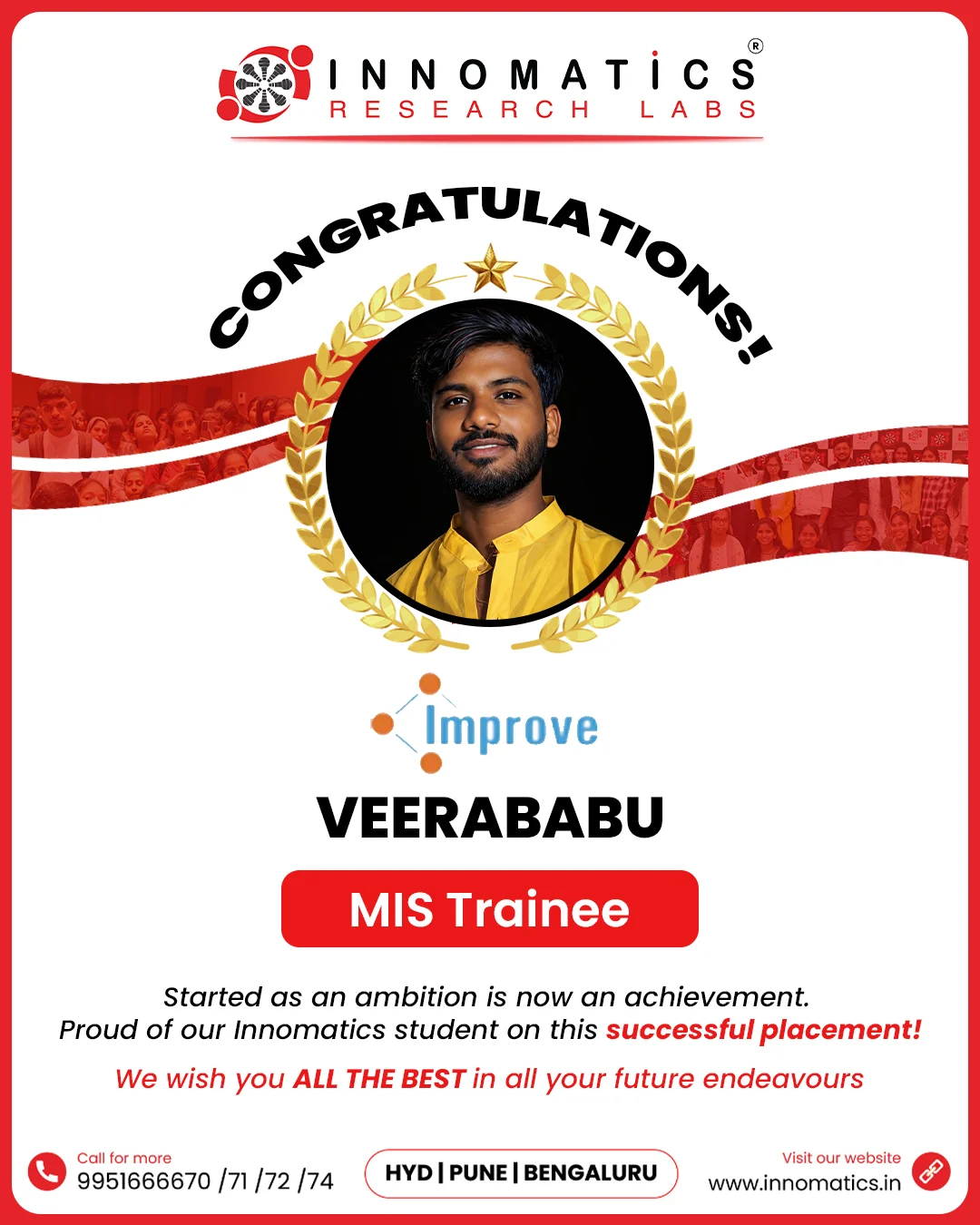
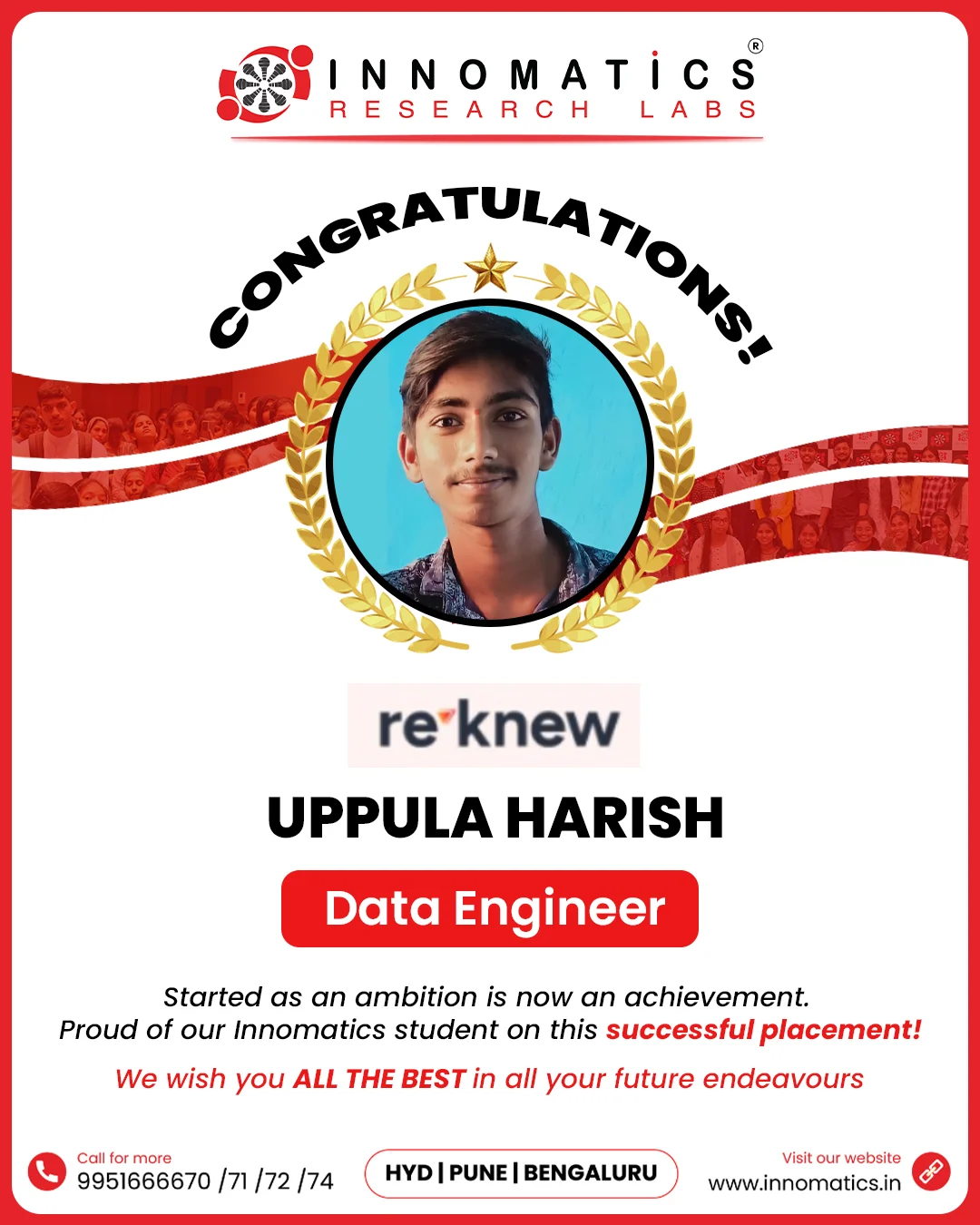
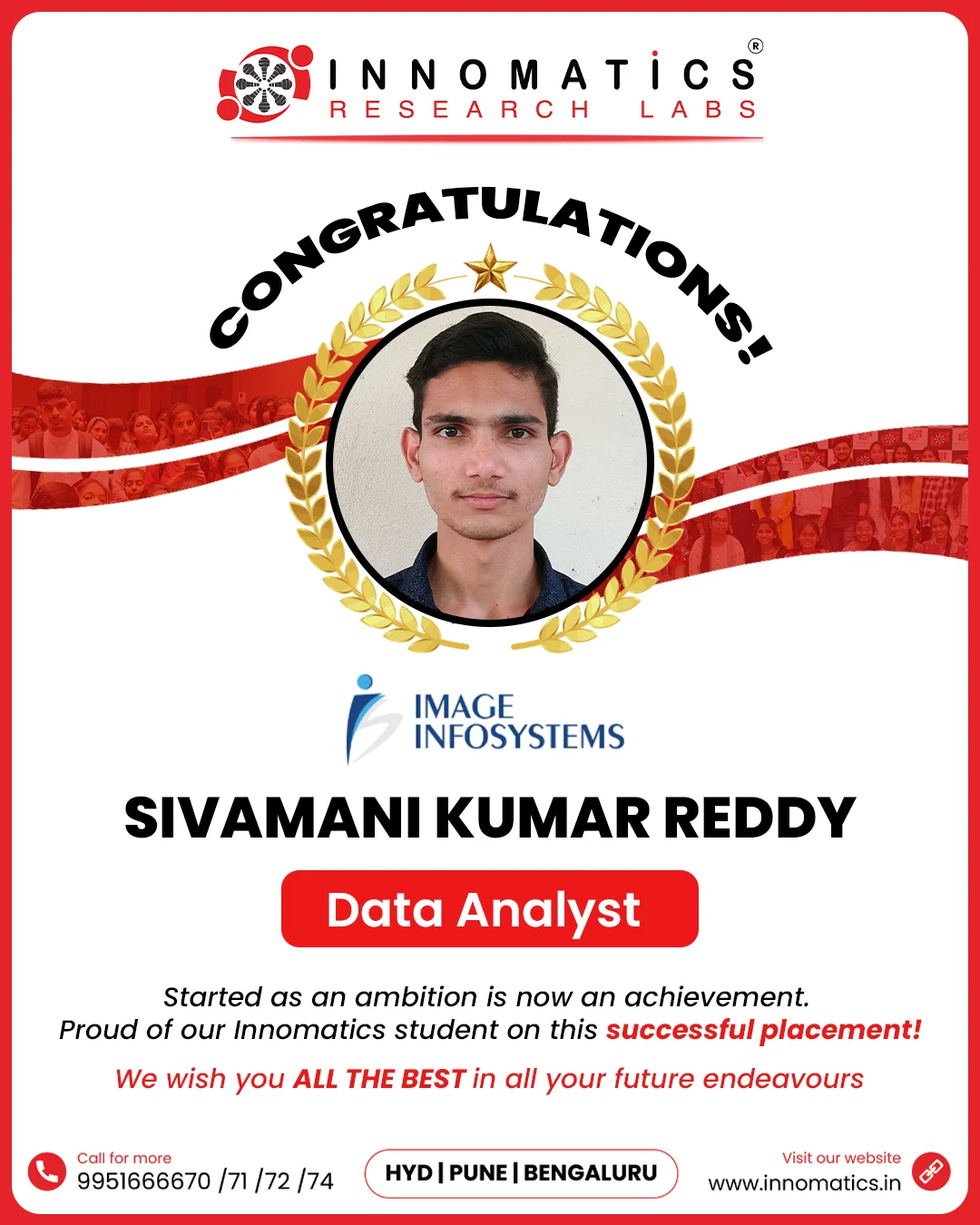
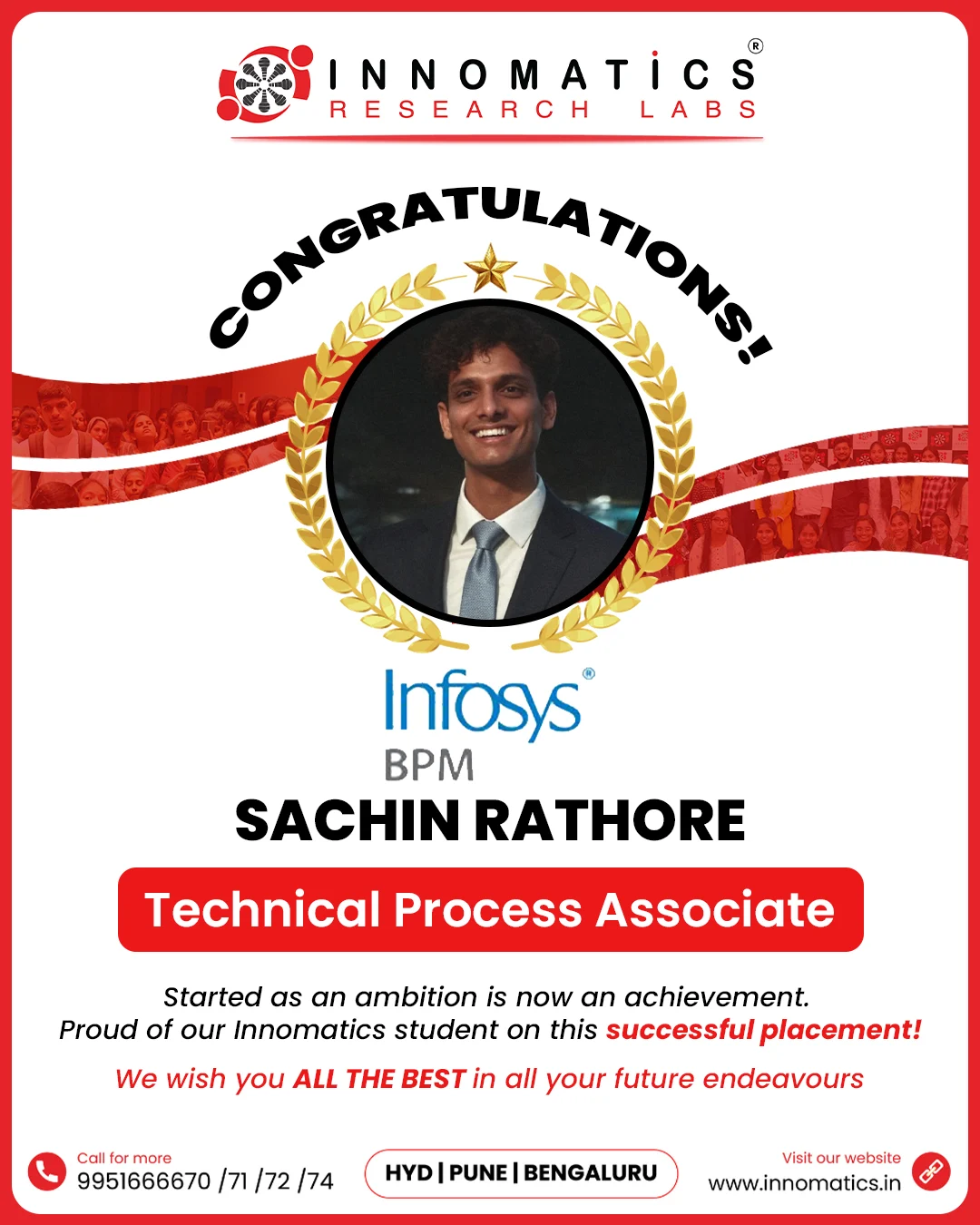
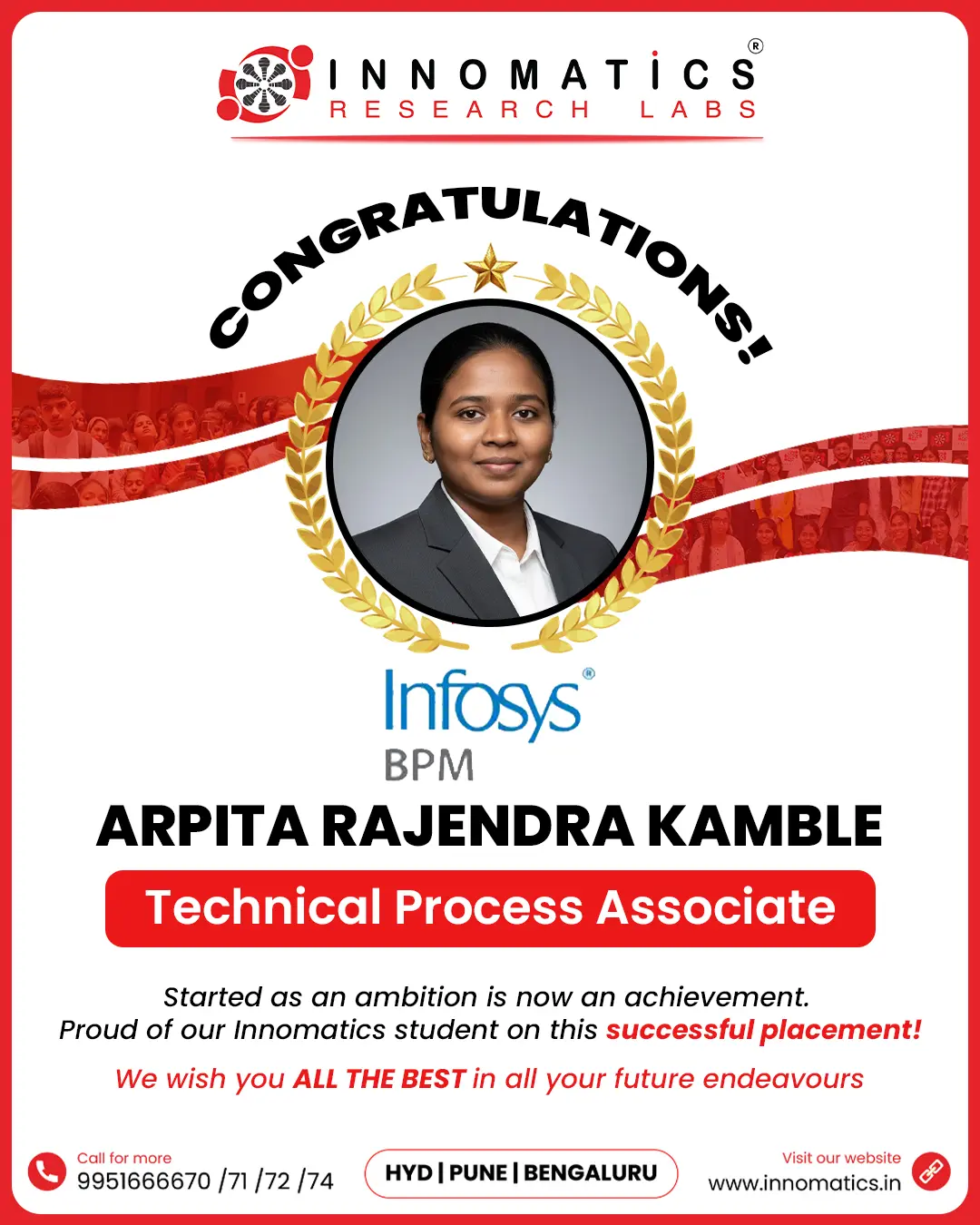
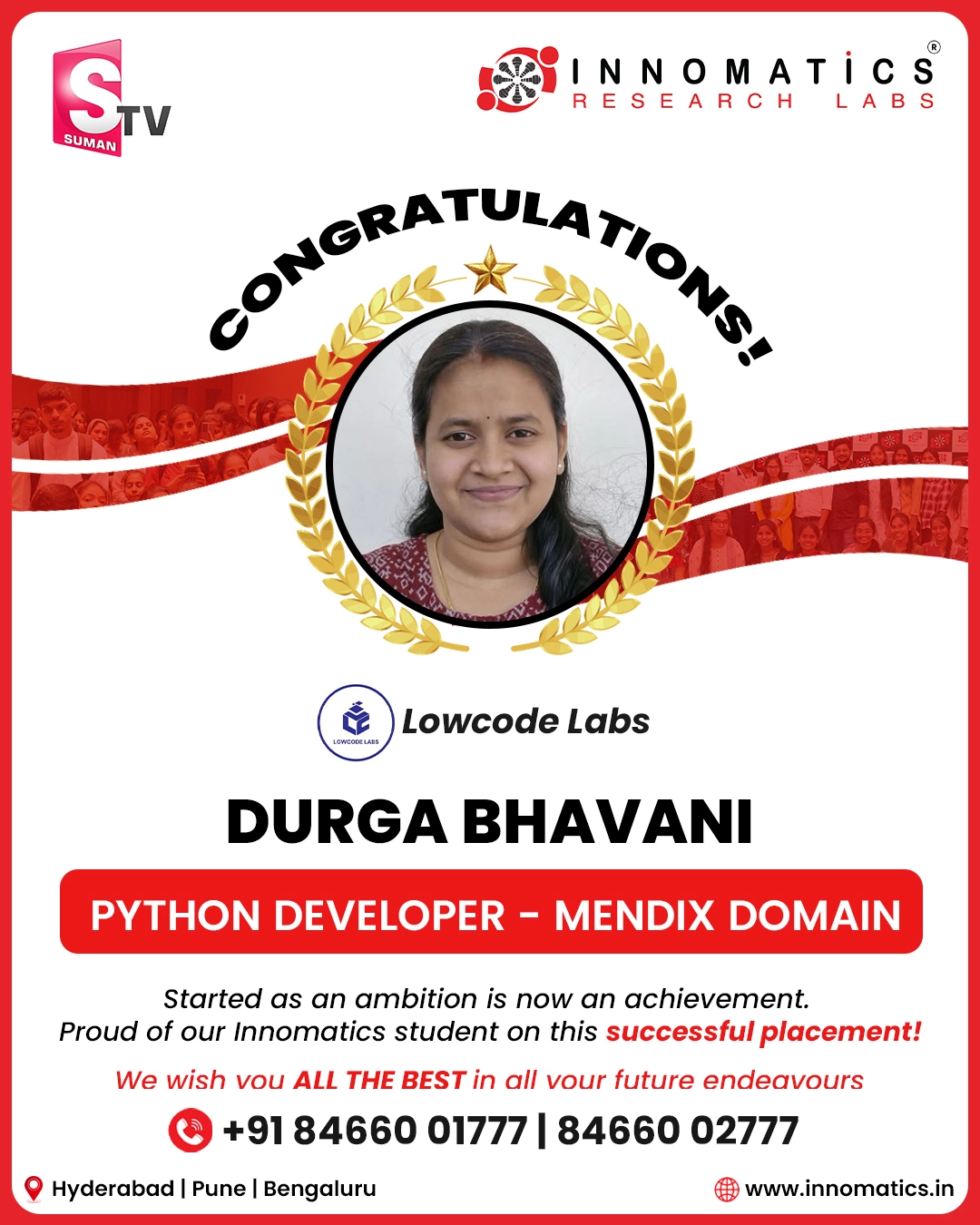
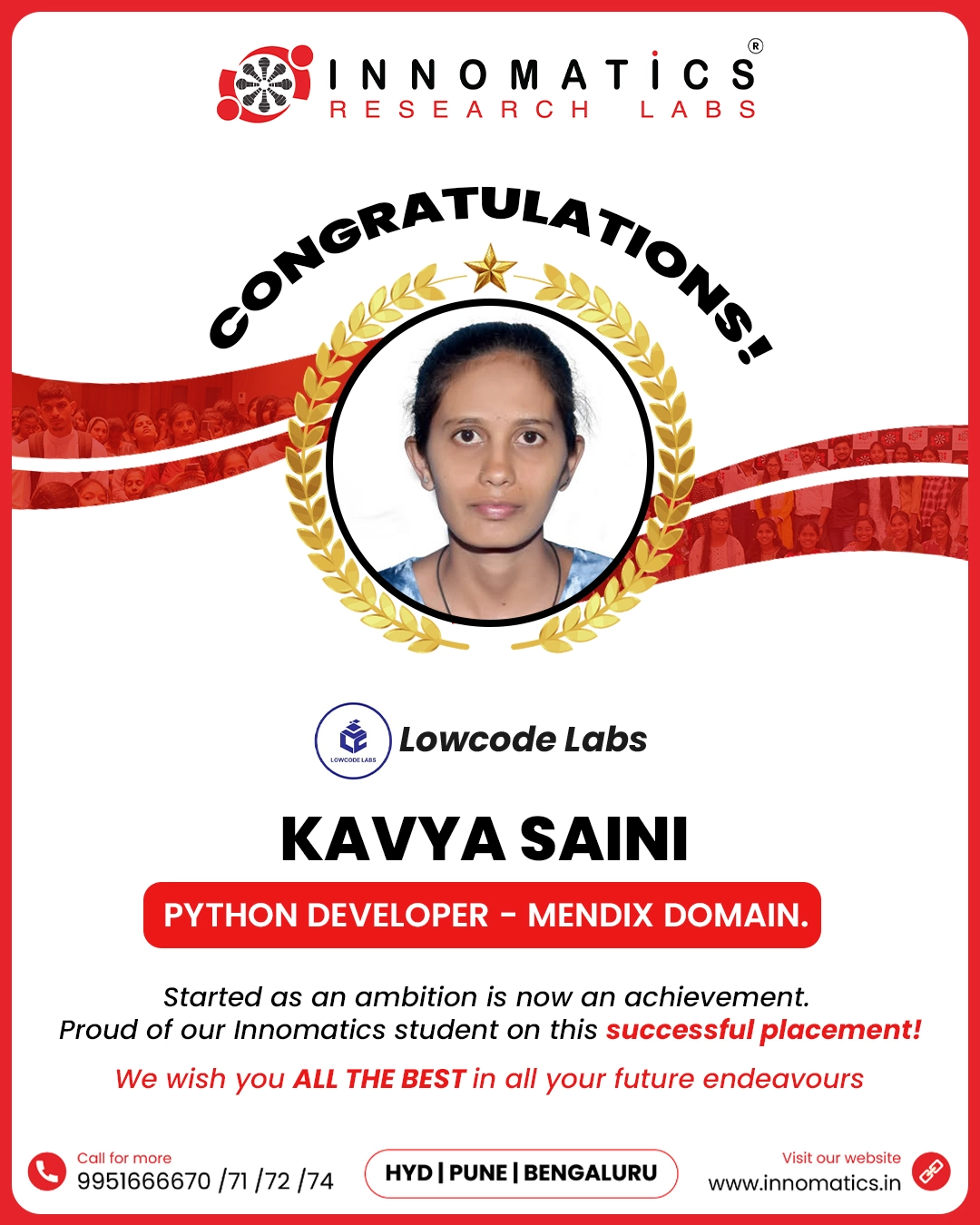
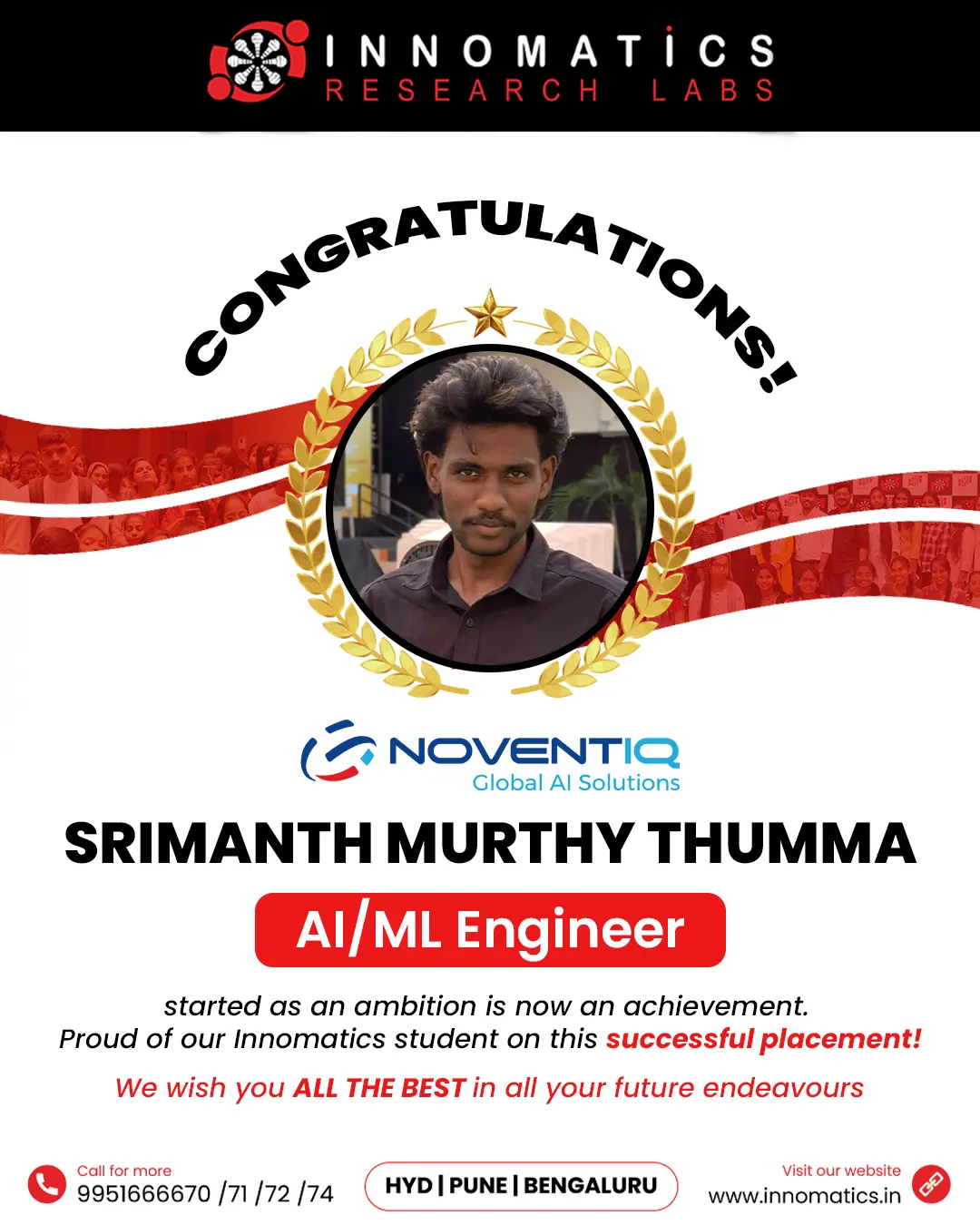
Meet Our Recently Placed Students


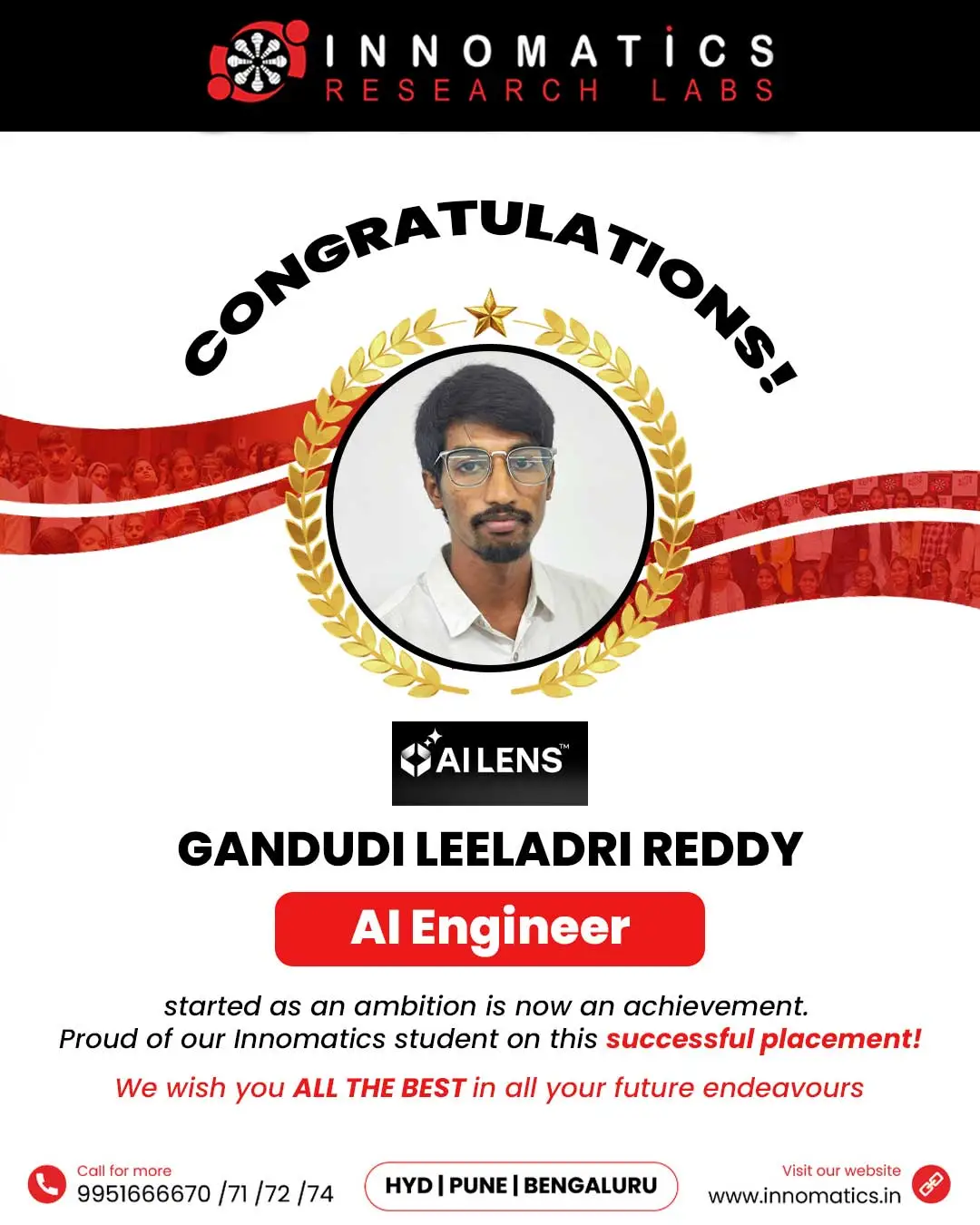
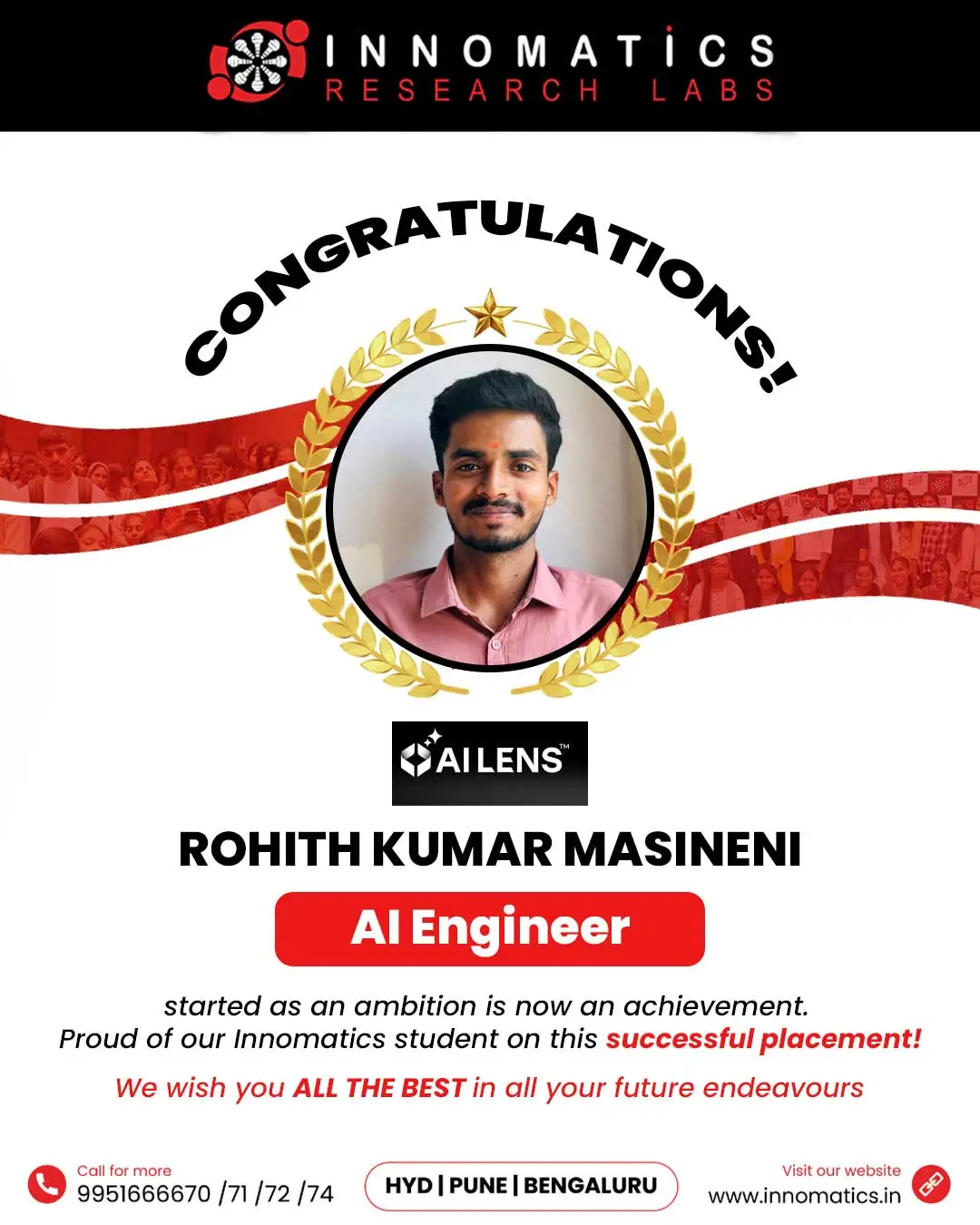
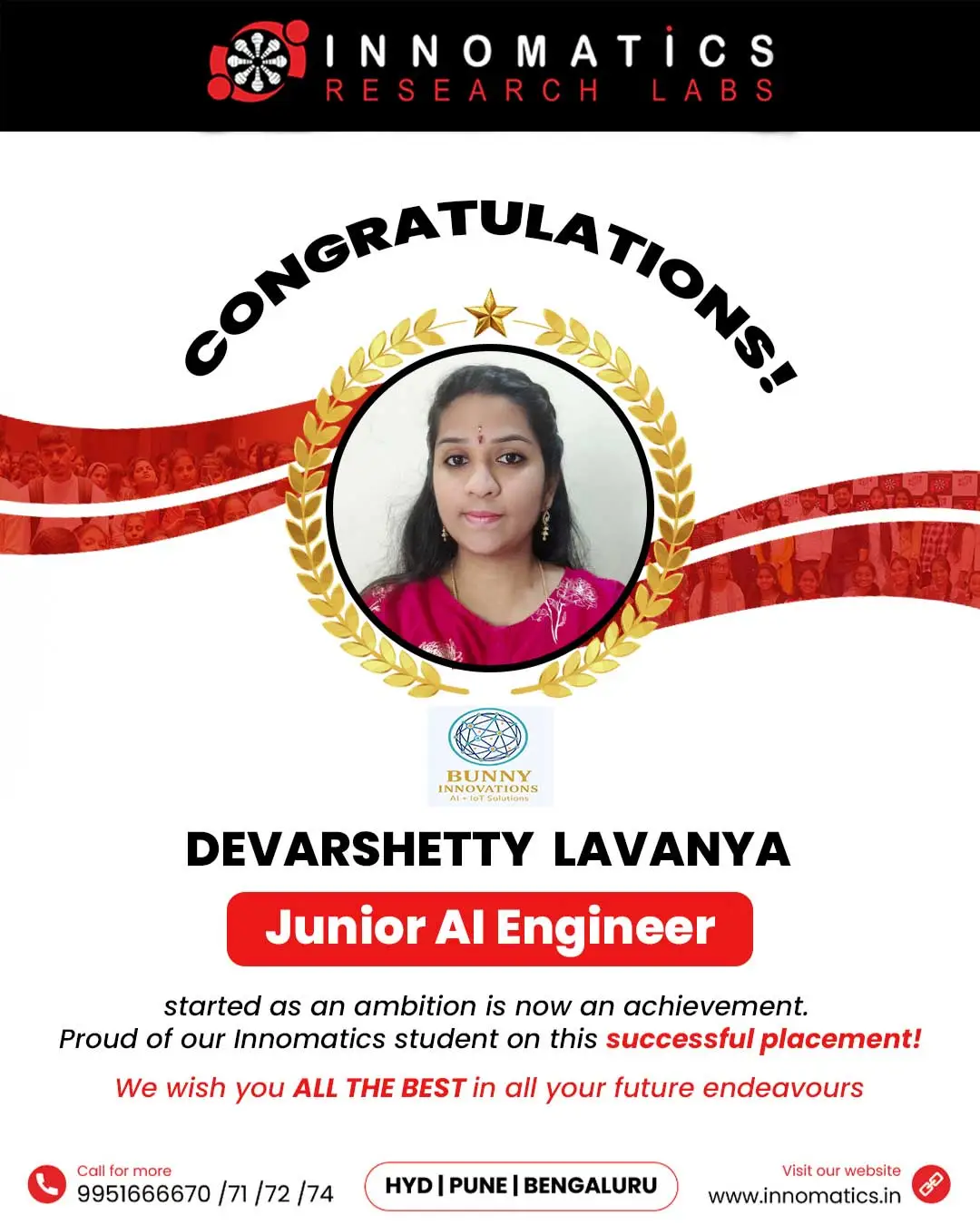
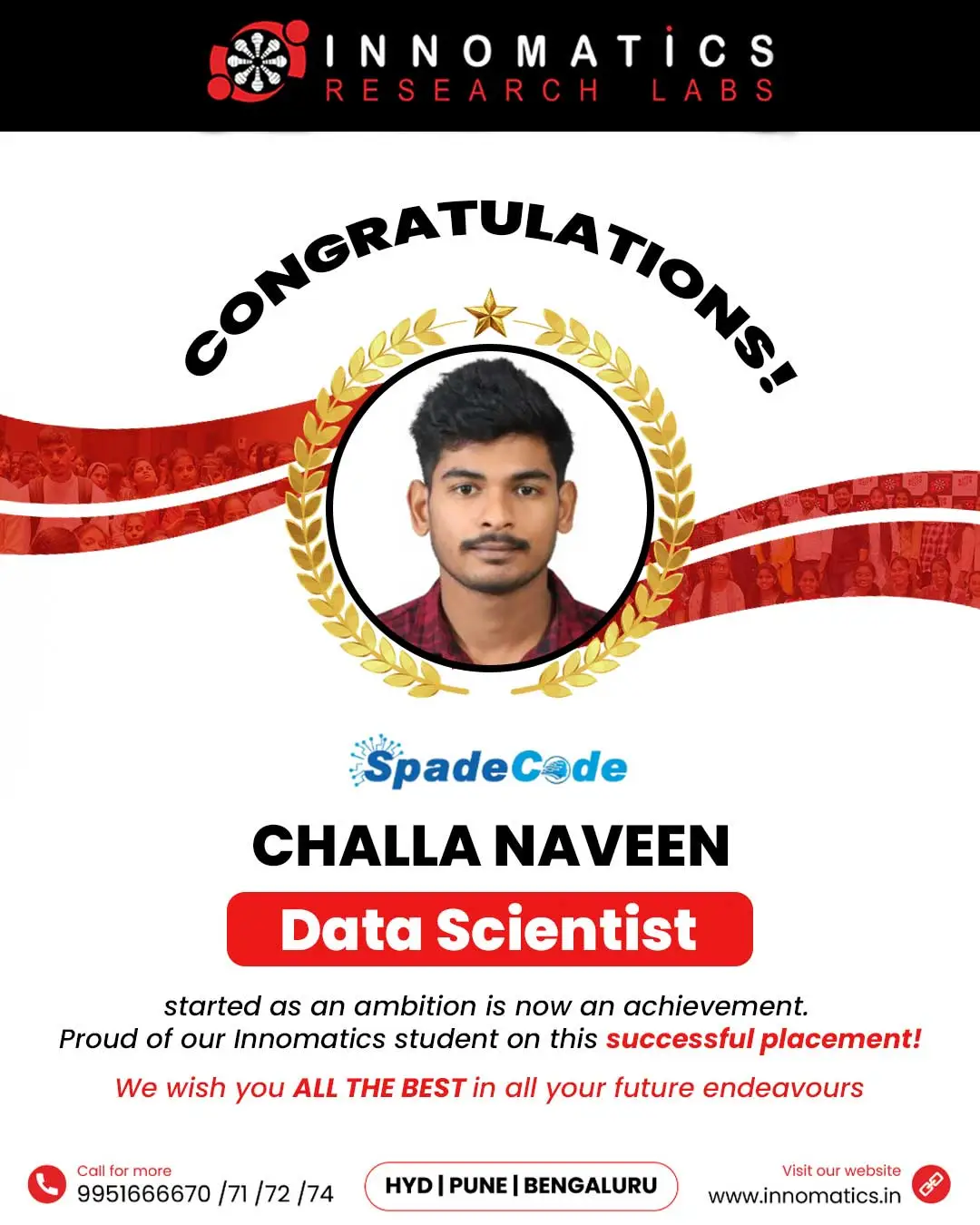

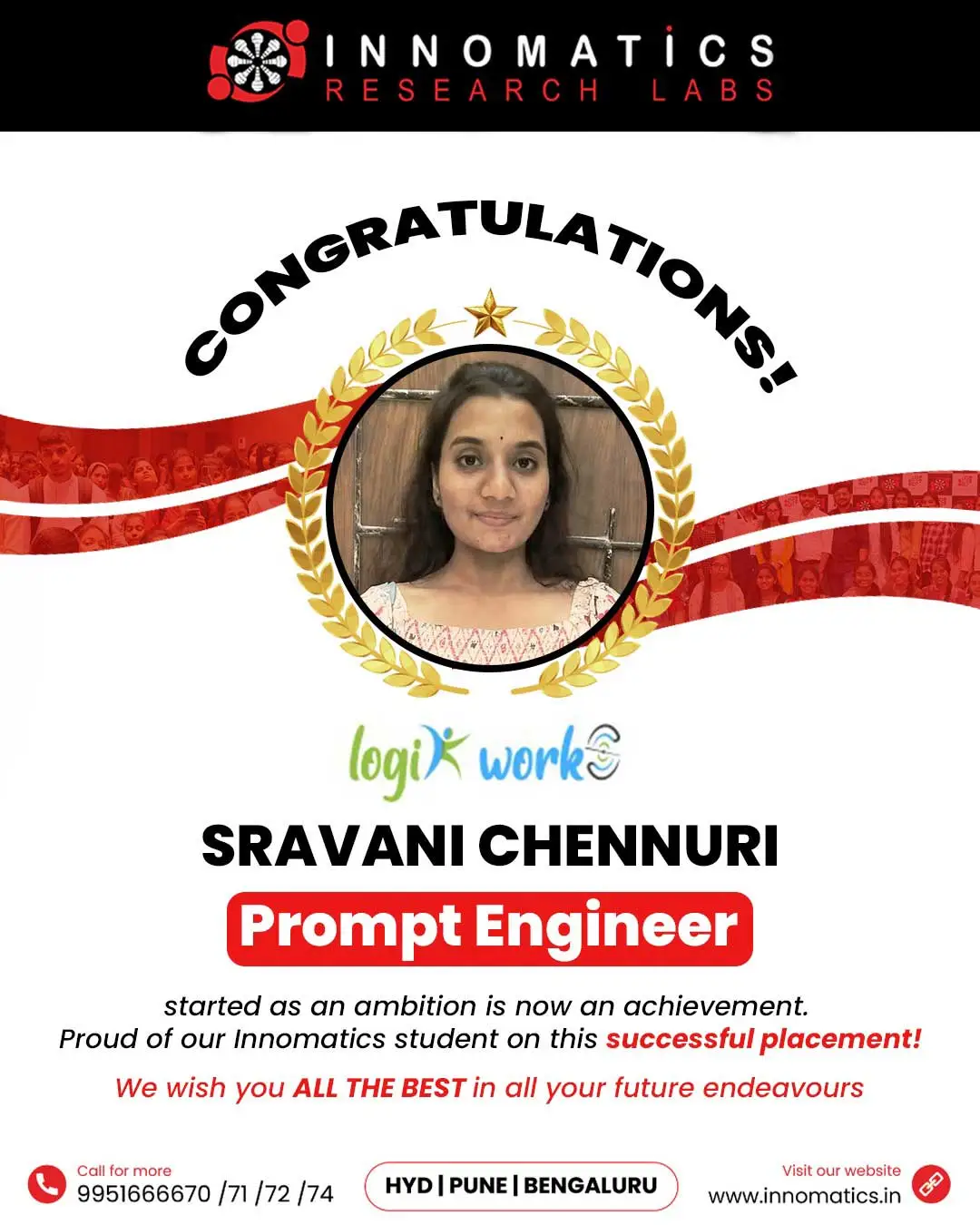
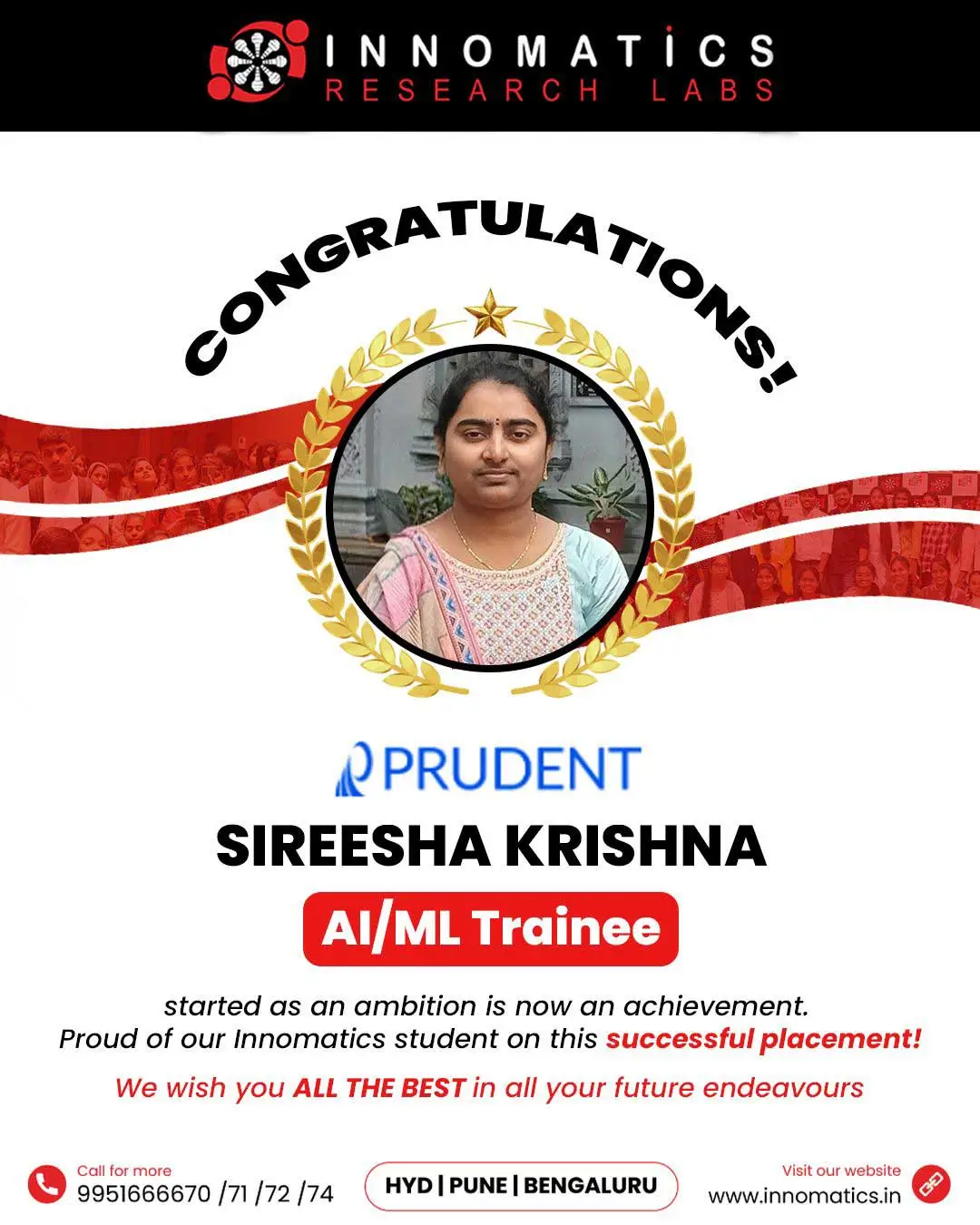

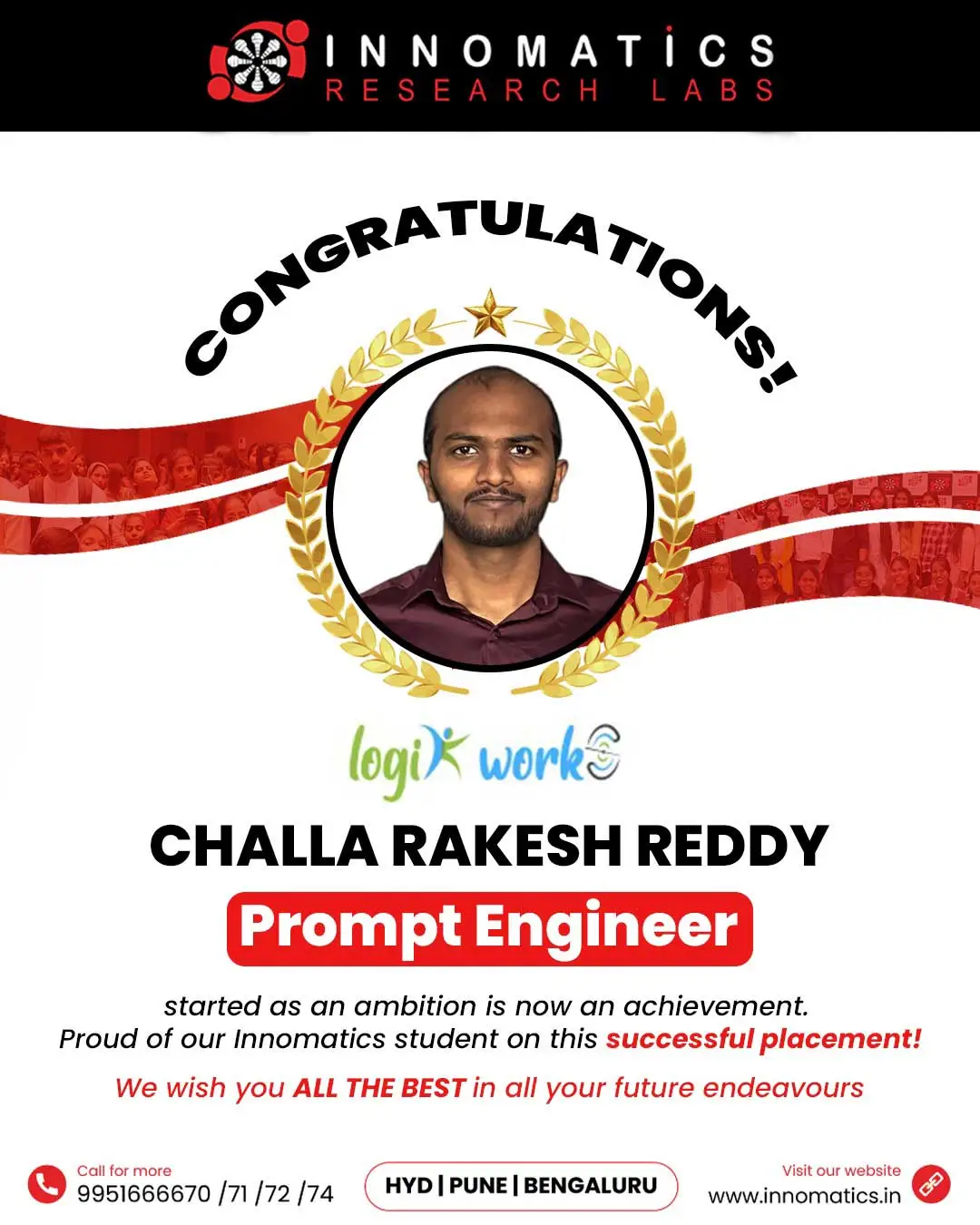

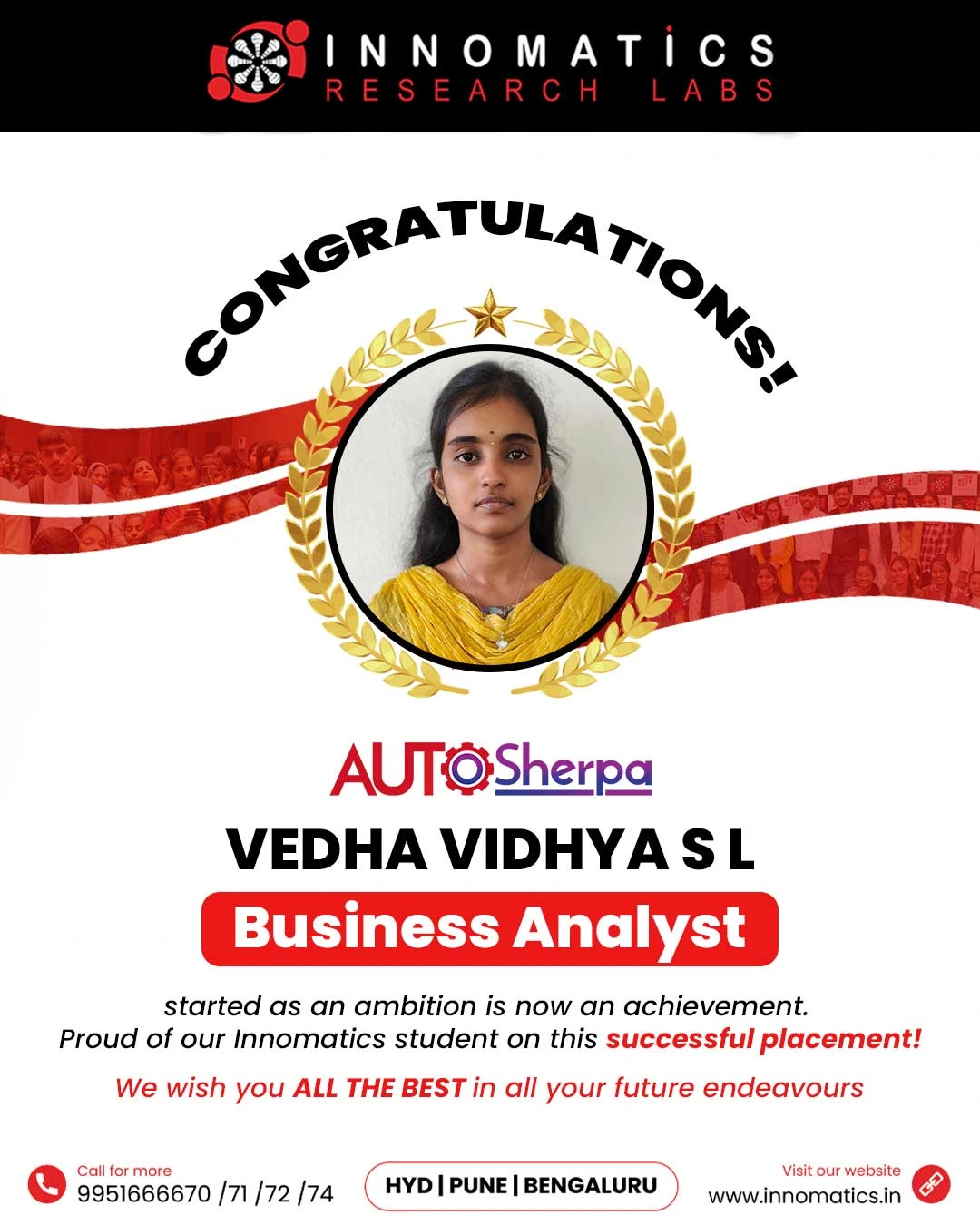
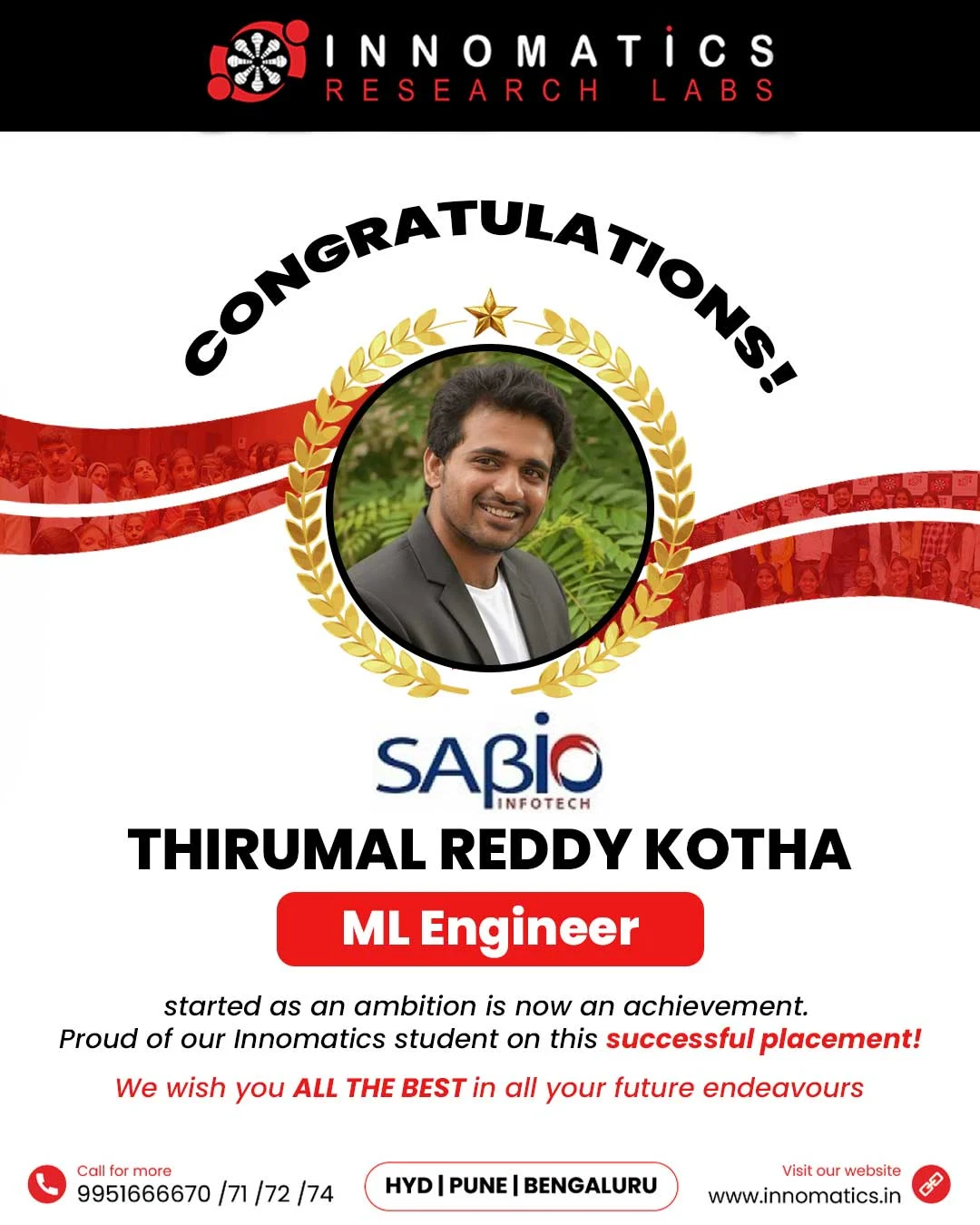
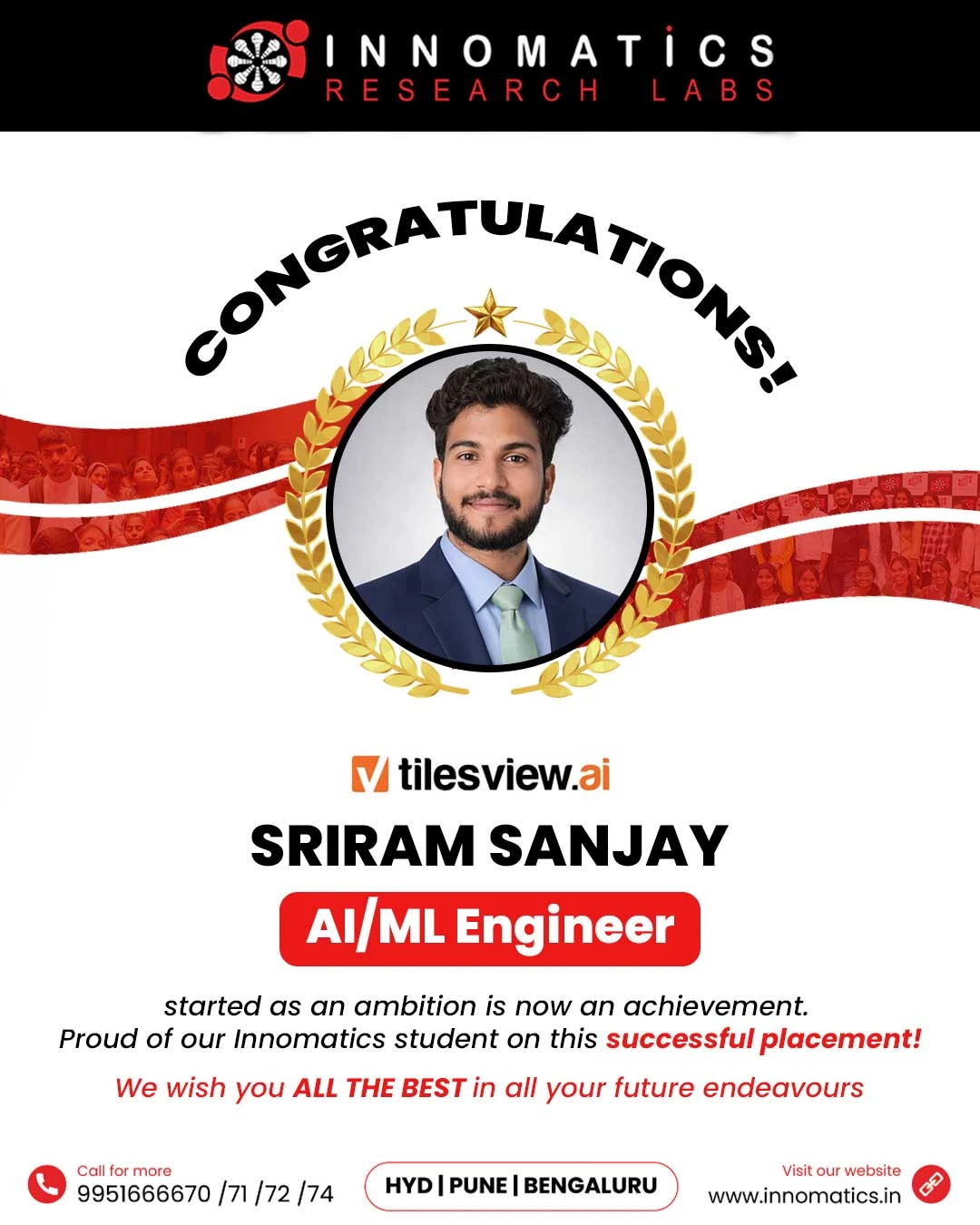
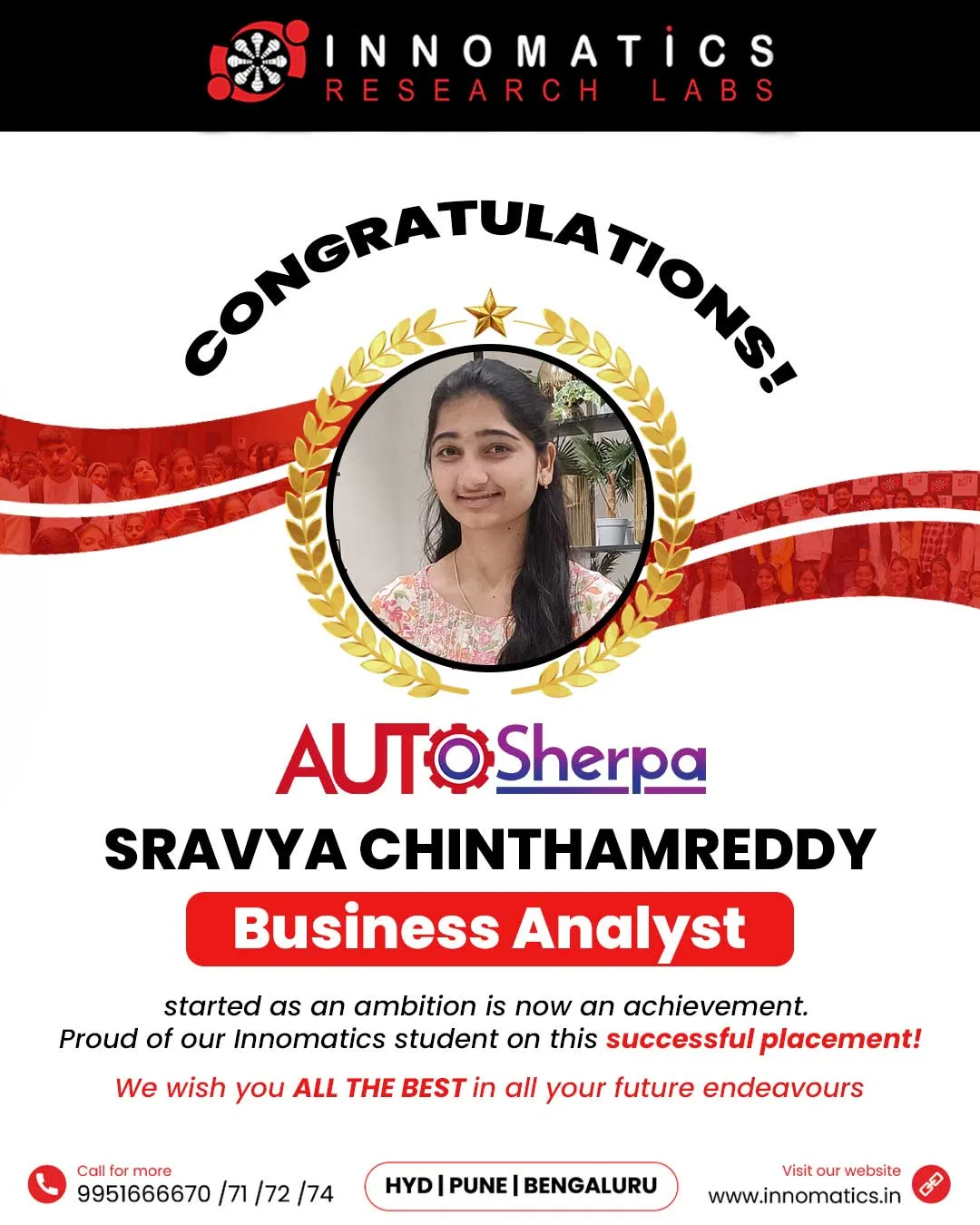
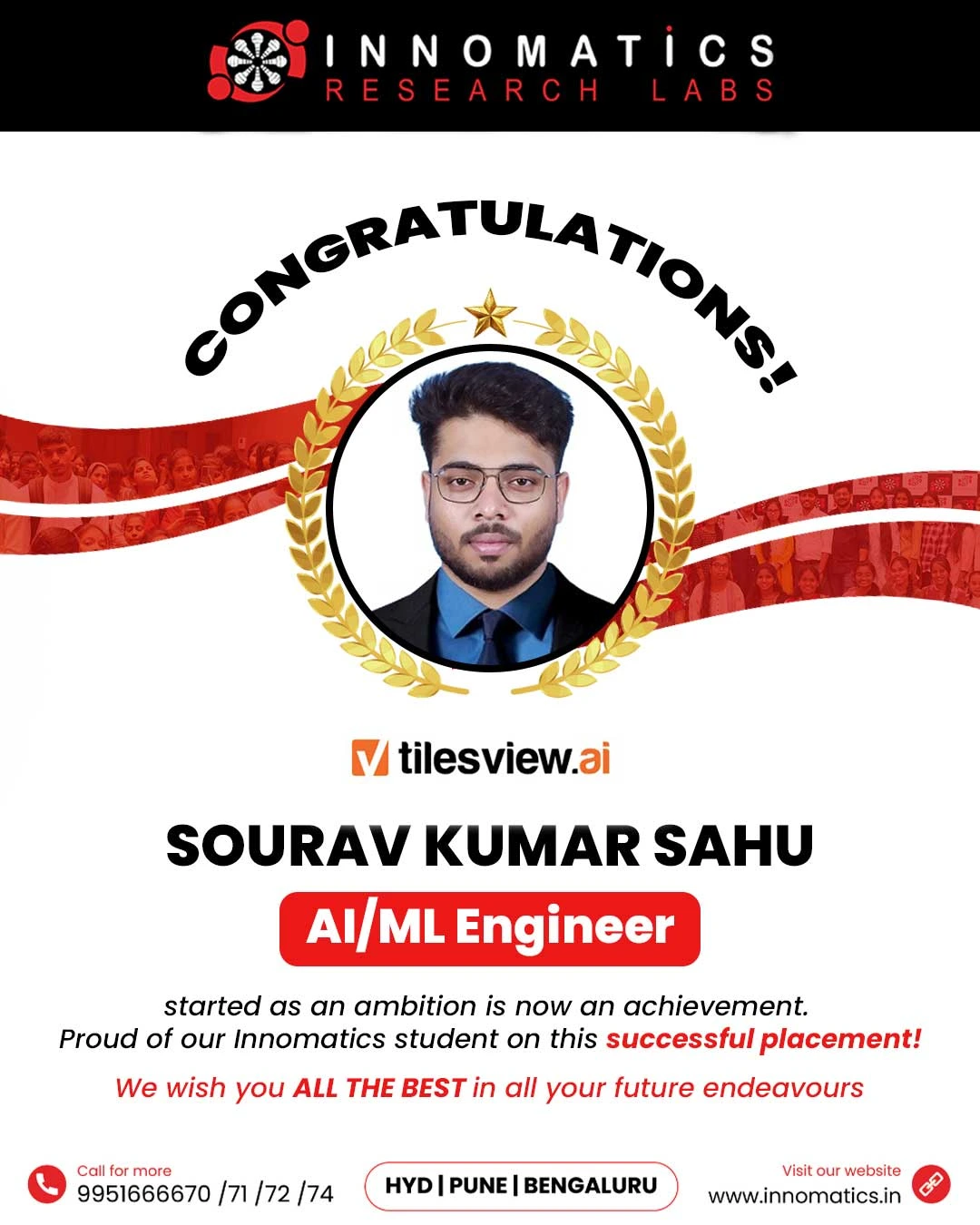
Success Stories of Innomatics Alumni


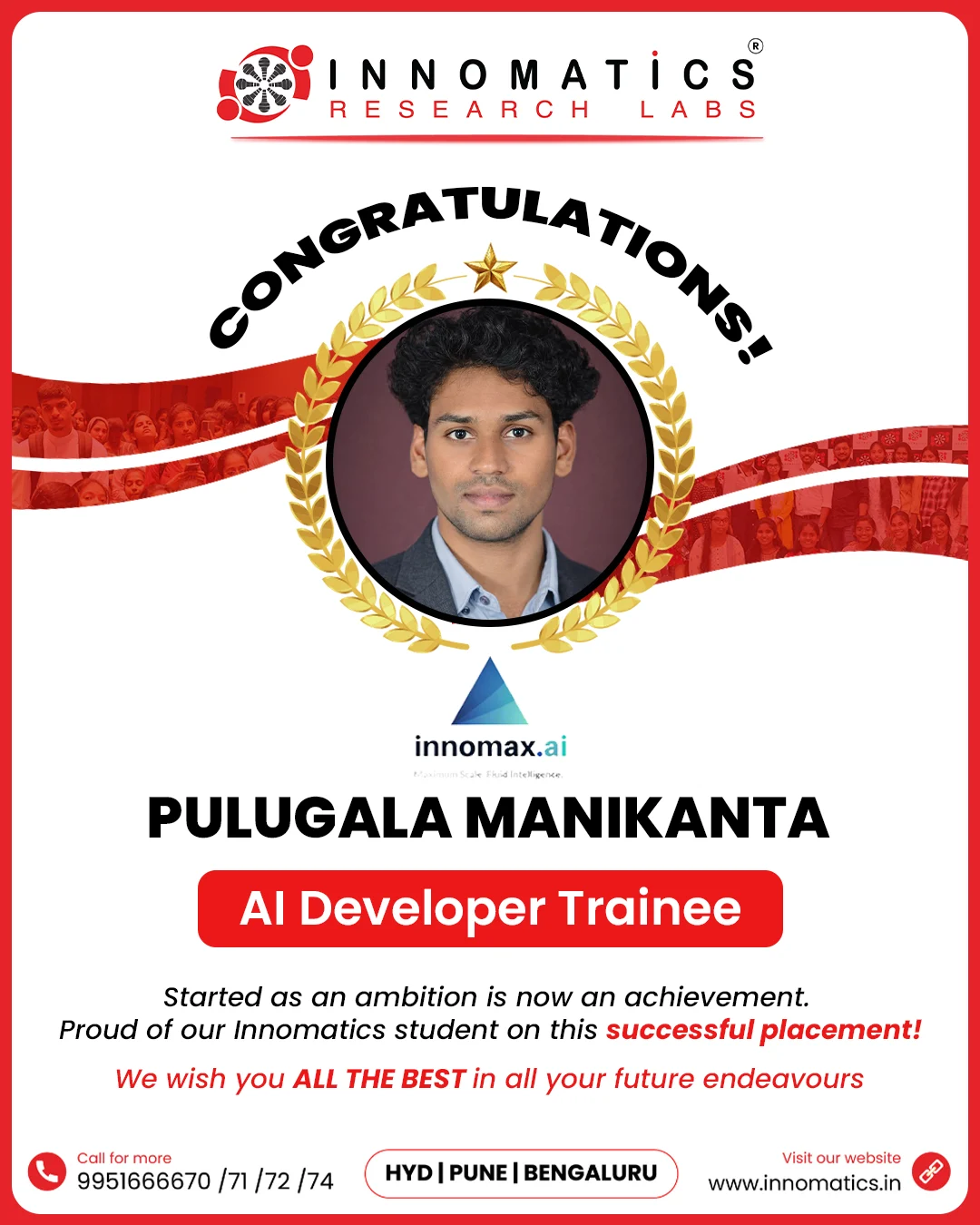
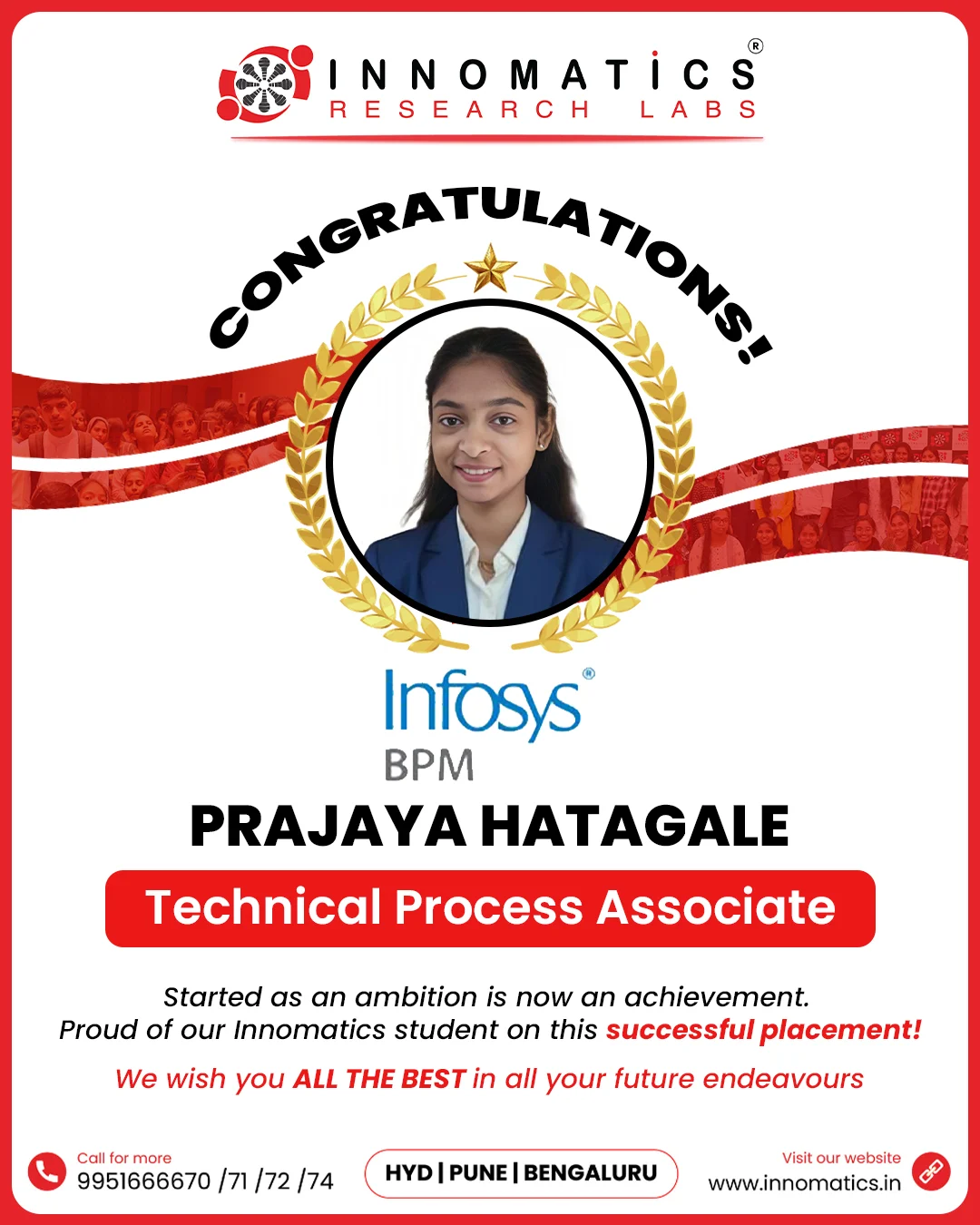


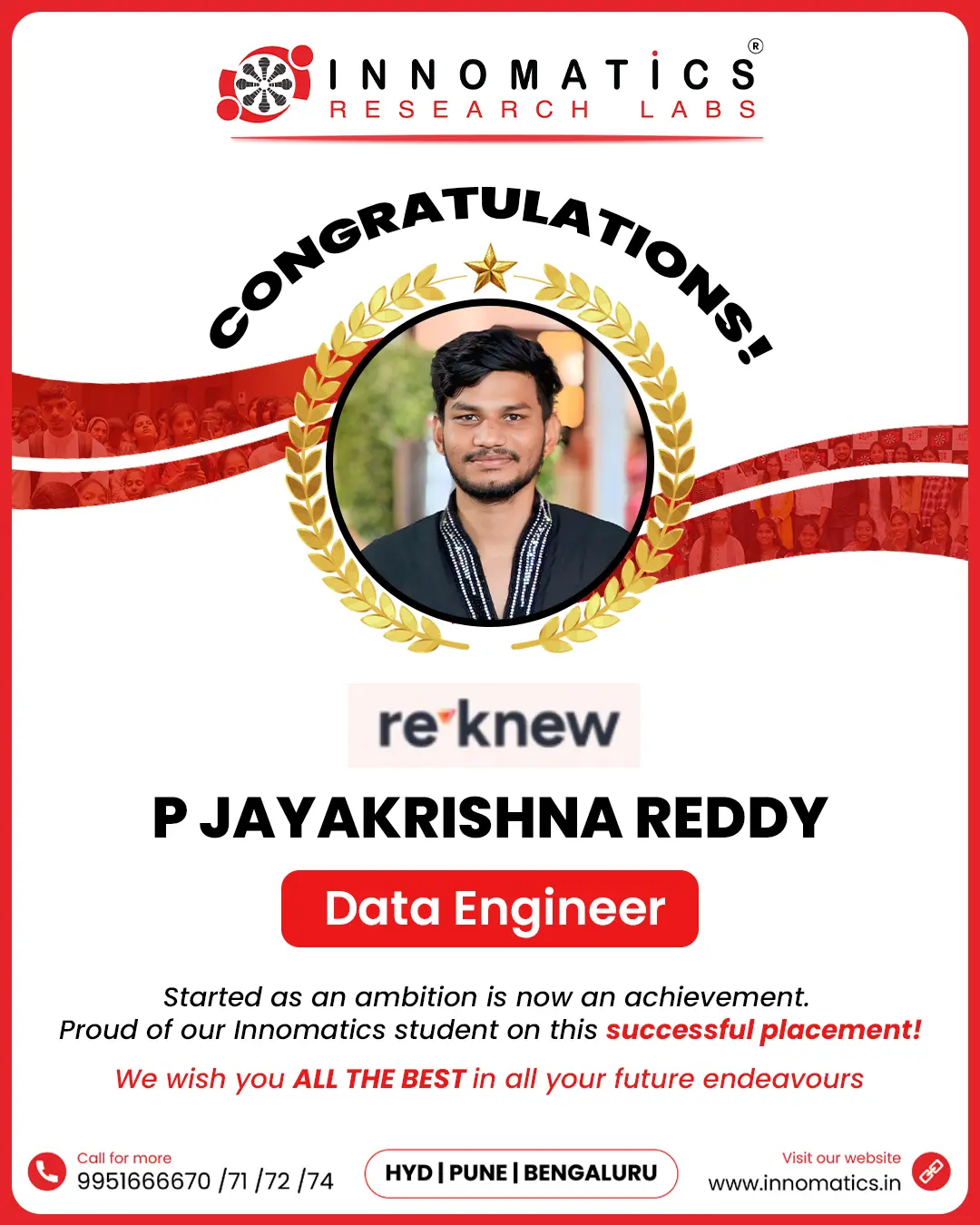

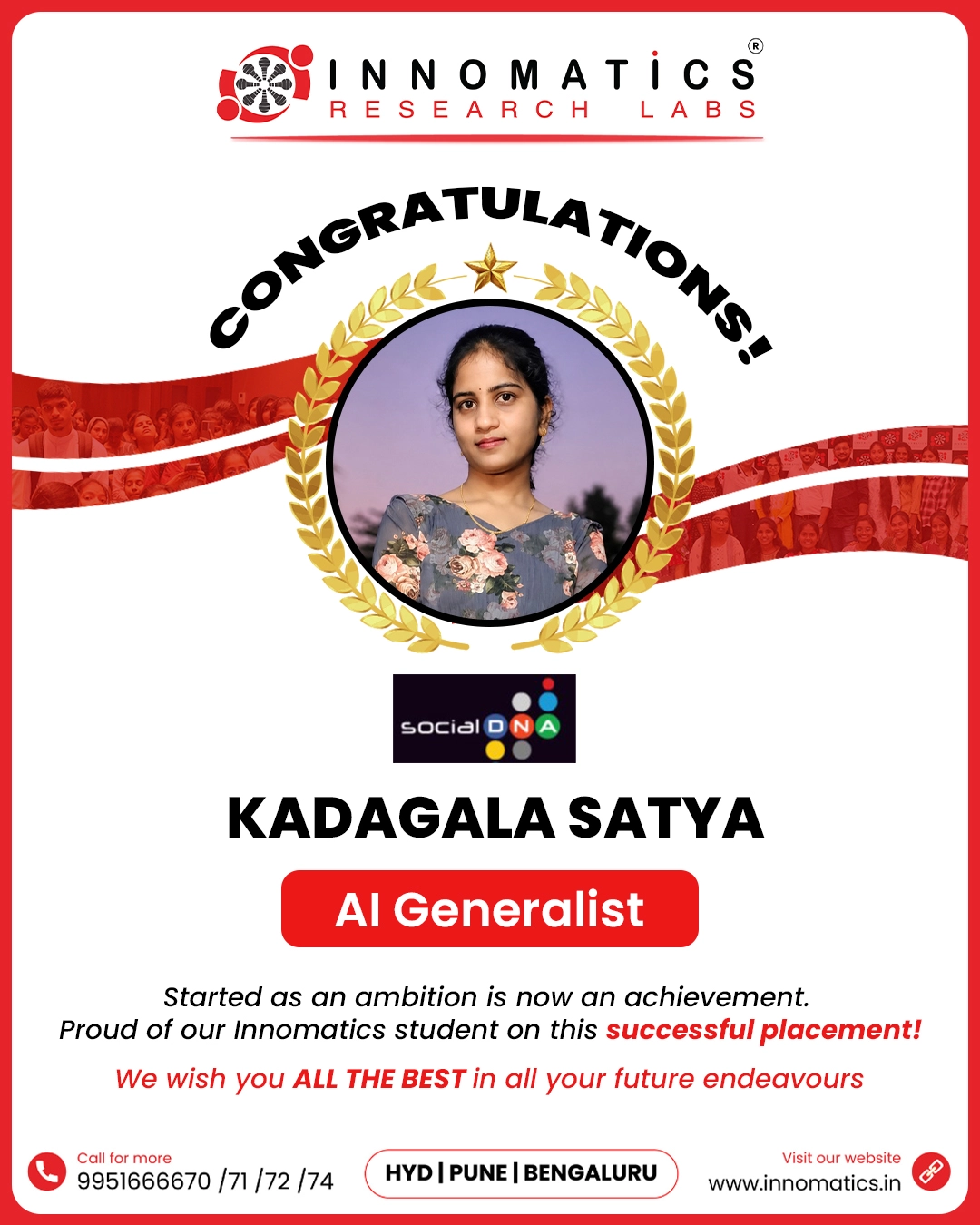


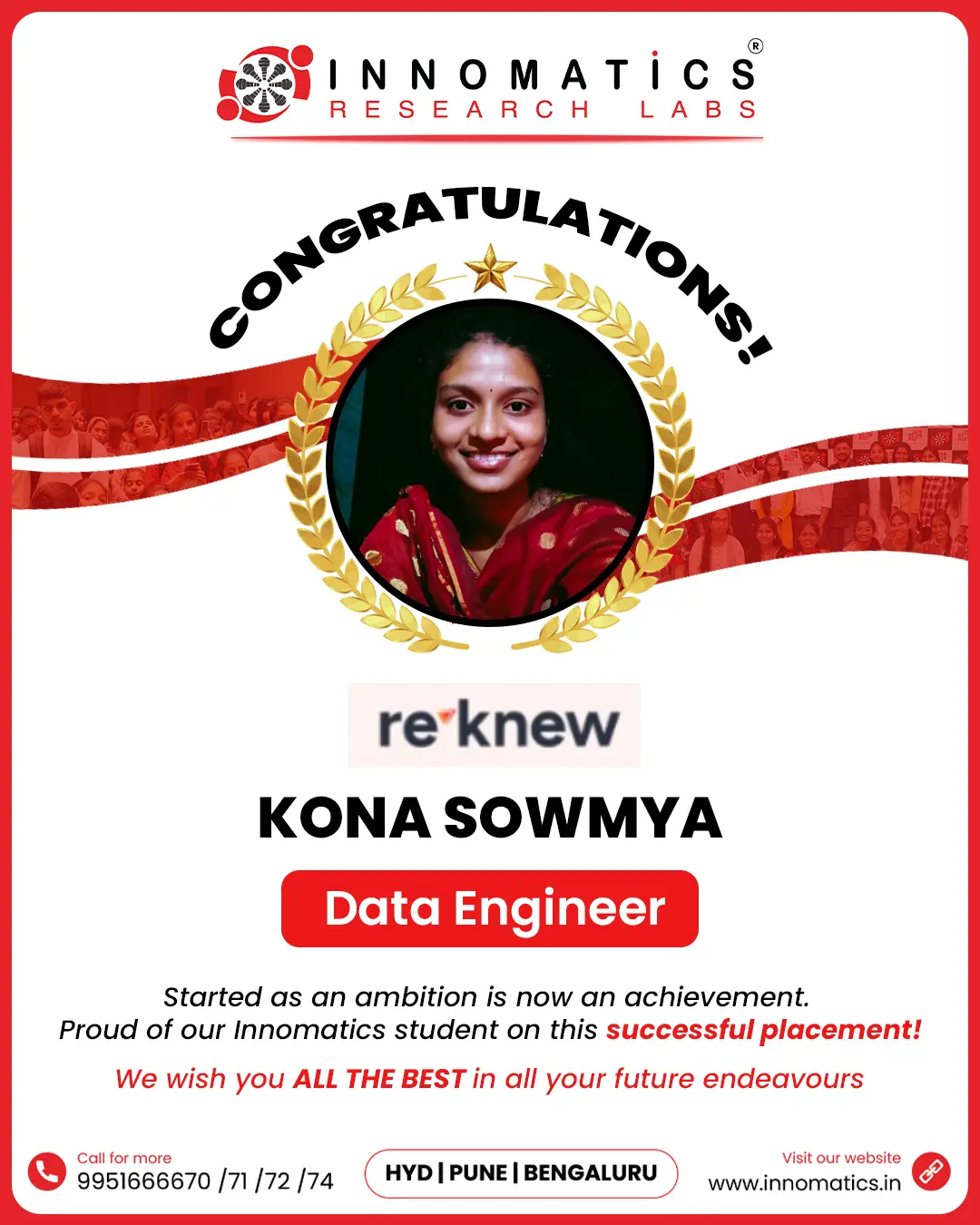
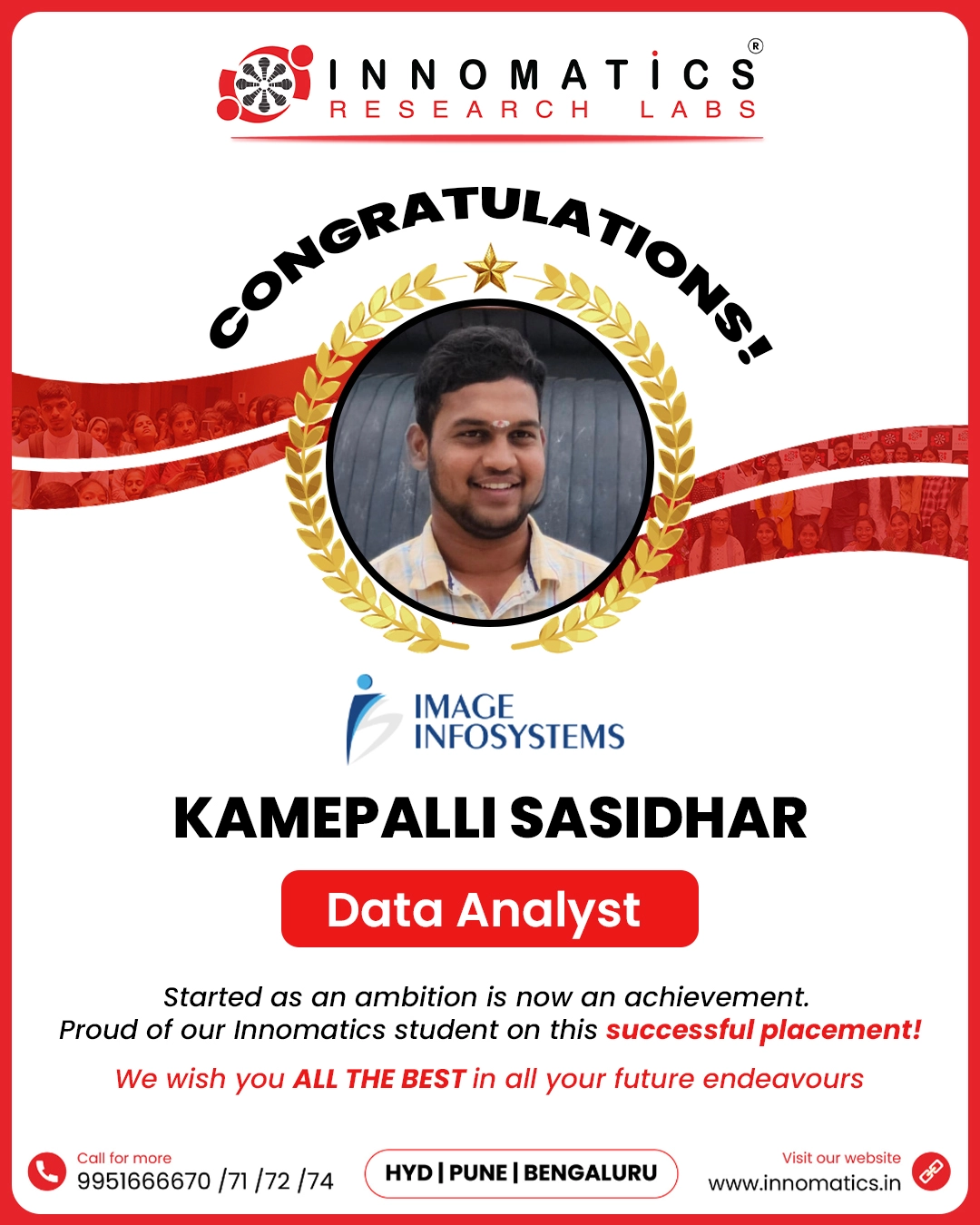
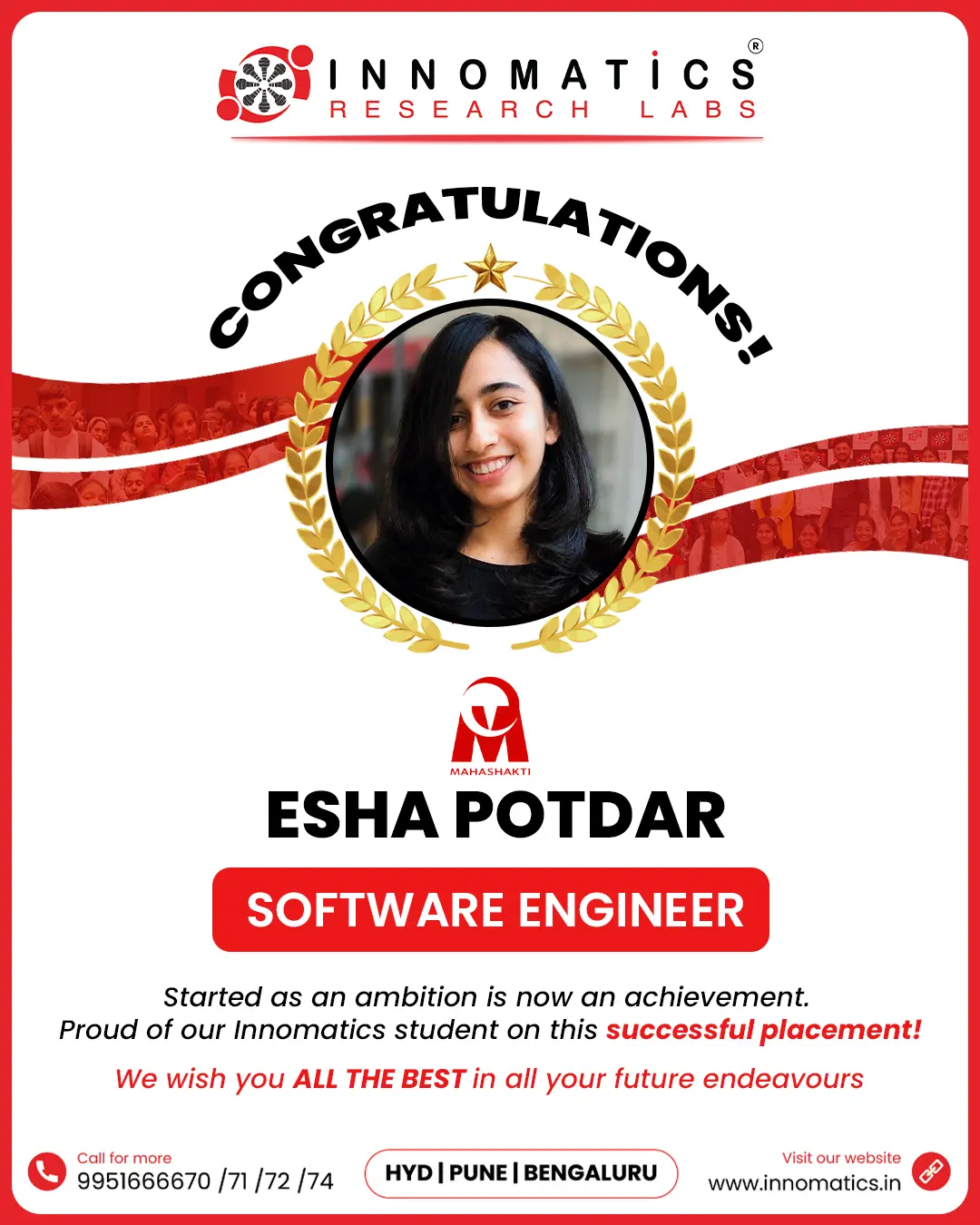
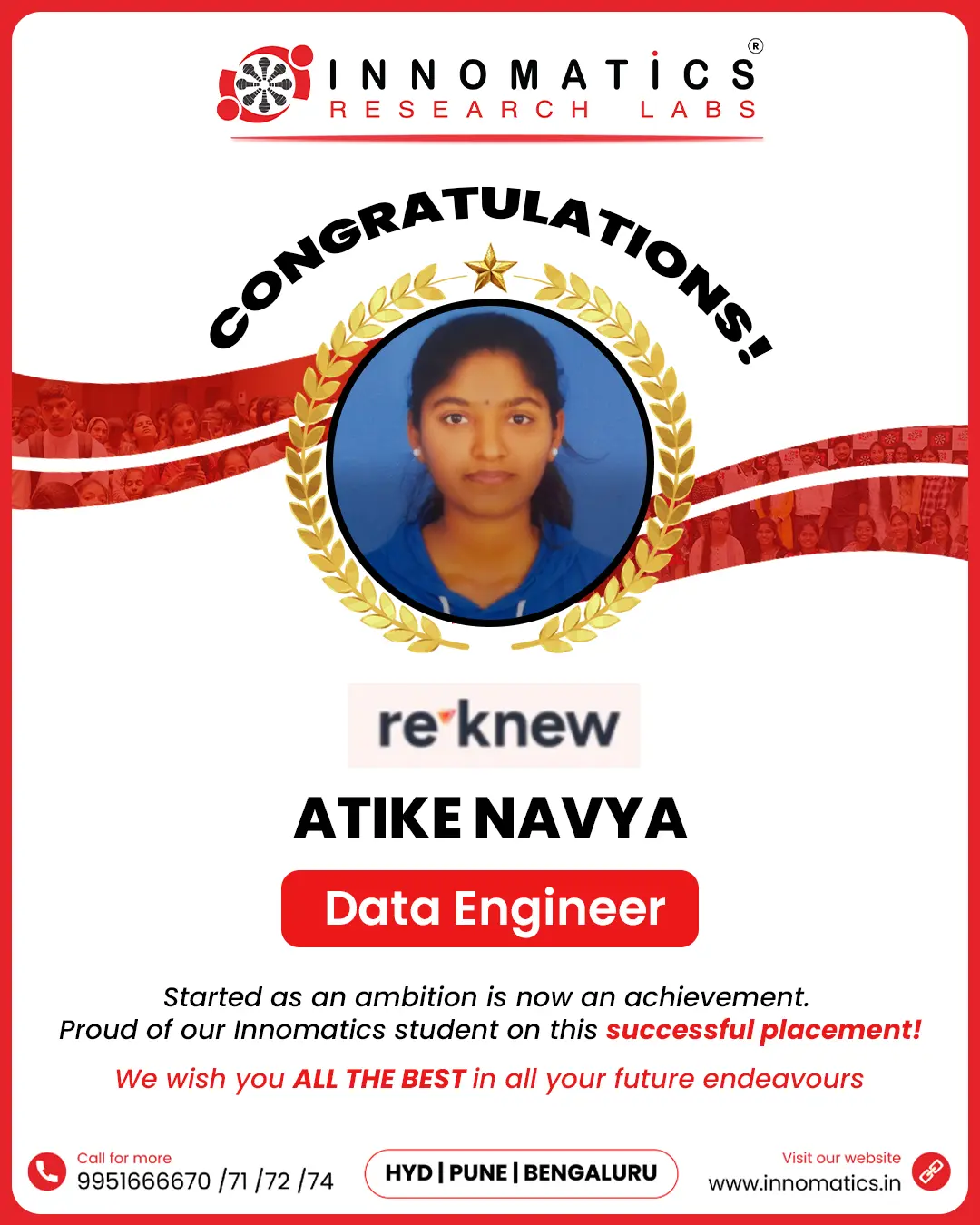







Learn What Others Don’t Teach – Only at Innomatics
 Holistic, industry-aligned curriculum covering Data Science, Full Stack Development, Data Analysis, and Generative AI using modern tools and real-world workflows
 Fragmented curriculum with limited scope, often outdated and lacking practical relevanceWell-structured, beginner-centric bootcamps designed with progressive learning paths and strong foundational supportUnstructured learning experience with minimal guidance for beginnersDeep integration of Generative AI through hands-on projects, real-world applications, and exposure to tools like ChatGPT and LLM ecosystemsSuperficial or theoretical coverage of Generative AI with limited practical exposureDiverse, career-oriented specializations including Data Science, Full Stack Development, Data Analysis, and Artificial IntelligenceGeneric specializations with little alignment to current industry demandsExtensive portfolio of real-time, industry-grade projects with complete end-to-end implementationBasic or academic-level projects with limited real-world applicabilityAdvanced capstone projects focused on solving real business challenges with measurable outcomesPredefined or limited capstone options with minimal complexityEstablished alumni network placed in leading organizations, supported by continuous career guidance and community engagementLimited alumni presence with minimal long-term career supportImmersive learning experience with 70+ case studies, live datasets, hackathons, and intensive practical sessionsReliance on pre-built datasets with reduced emphasis on hands-on practiceGuidance from industry professionals, IIT/NIT alumni, and seasoned mentors with real-world expertisePrimarily platform-driven learning with limited access to expert mentorshipHolistic, industry-aligned curriculum covering Data Science, Full Stack Development, Data Analysis, and Generative AI using modern tools and real-world workflowsFragmented curriculum with limited scope, often outdated and lacking practical relevanceWell-structured, beginner-centric bootcamps designed with progressive learning paths and strong foundational supportUnstructured learning experience with minimal guidance for beginnersDeep integration of Generative AI through hands-on projects, real-world applications, and exposure to tools like ChatGPT and LLM ecosystemsSuperficial or theoretical coverage of Generative AI with limited practical exposureDiverse, career-oriented specializations including Data Science, Full Stack Development, Data Analysis, and Artificial IntelligenceGeneric specializations with little alignment to current industry demandsExtensive portfolio of real-time, industry-grade projects with complete end-to-end implementationBasic or academic-level projects with limited real-world applicabilityAdvanced capstone projects focused on solving real business challenges with measurable outcomesPredefined or limited capstone options with minimal complexityEstablished alumni network placed in leading organizations, supported by continuous career guidance and community engagementLimited alumni presence with minimal long-term career supportImmersive learning experience with 70+ case studies, live datasets, hackathons, and intensive practical sessionsReliance on pre-built datasets with reduced emphasis on hands-on practiceGuidance from industry professionals, IIT/NIT alumni, and seasoned mentors with real-world expertisePrimarily platform-driven learning with limited access to expert mentorship
What Our Data Science Students Say About Innomatics
Data Science Career Opportunities & Job Roles After Course
In-Demand Careers in Data Science
Data Science professionals are in high demand across IT, healthcare, finance, retail, and e-commerce. Companies actively hire for roles in Machine Learning, AI, Data Analytics, Business Intelligence, and Automation. With digital transformation accelerating globally, Data Science is today’s most future-proof career. Start your journey with Hyderabad’s best Data Science course at Innomatics.
- Data Scientist
- Data Analyst
- Machine Learning Engineer
- Business Intelligence Analyst
- AI/ML Developer
- Deep Learning Engineer
- Natural Language Processing NLP Engineer
- Statistical Analyst
- Data Visualisation Specialist
- Data Product Manager

Frequently asked questions
Which institute is best for learning Data Science in Hyderabad?
Innomatics Research Labs is one of Hyderabad’s leading Data Science training institutes, with 550+ successful batches and 20,000+ career transitions in Data Analyst, ML, and AI roles. Our curriculum is aligned with NASSCOM FutureSkills Prime and the TIH IIT Bombay program, and we offer hands-on projects, real-world case studies, and dedicated placement support across 650+ hiring partners.
What is the fee for the Data Science course in Hyderabad?
Course fees vary based on the program duration, mode (online or classroom), and any ongoing offers. For the most accurate and current fee details,reach out to our team — we’ll walk you through the options based on your background and goals.
Is online Data Science training available in Hyderabad?
Yes. Innomatics offers both online and classroom training for the Data Science course, so you can choose the format that fits your schedule and learning style, with the same curriculum, mentorship, and placement support either way.
Does Innomatics provide placement support after the Data Science course?
Yes. Every learner gets dedicated placement support, including 1-on-1 career guidance from industry mentors and access to our network of 650+ hiring partners across industries.
Will I receive a certificate after completing the Data Science course?
Yes. On successful completion, you’ll receive an industry-recognized certification aligned with NASSCOM FutureSkills Prime and the TIH at IIT Bombay program.
Why is Hyderabad a good city to learn Data Science?
Hyderabad is home to a large and growing IT and analytics industry, with major tech companies, startups, and GCCs (Global Capability Centres) actively hiring for Data Science, AI, and ML roles giving learners strong local access to internships, networking, and job opportunities right where they train.